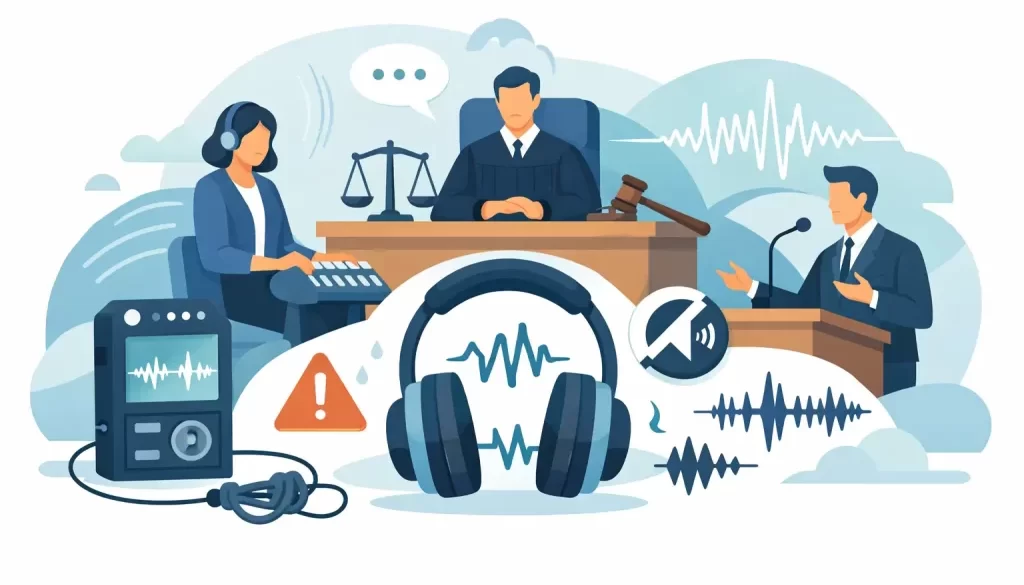
A hearing can be flawless in the room and still fall apart in the recording. That is the frustrating reality behind many court reporting agency audio problems. When speech is muffled, channels drift out of sync, or a key speaker sits too far from the microphone, the damage does not stay technical for long. It becomes a delivery issue, a credibility issue, and in some cases a costly evidential issue.
For agencies, legal teams and any business handling spoken record, audio quality is not a nice extra. It is the foundation the transcript depends on. If the recording is unclear, no amount of last-minute admin can turn it into a clean, reliable record. That is why audio problems need to be treated as a process failure, not just an editing headache.
Why court reporting agency audio problems matter so much
In most commercial audio, poor sound is irritating. In legal or quasi-legal settings, it can be far more serious. A missed phrase may alter meaning. Crosstalk can make attribution difficult. Background noise can obscure names, dates and figures that matter.
The practical cost shows up quickly. Transcribers take longer. Clarification requests increase. Turnaround slips. Clients lose confidence because they are paying for certainty and getting caveats instead. Even if the final transcript is completed, the process feels unstable, and that affects trust.
This is where many organisations underestimate the problem. They assume audio can always be cleaned up later. Sometimes it can be improved, but repair has limits. Human editors can remove hum, reduce background noise and improve consistency. They cannot recreate words that were never captured properly in the first place.
The most common causes of court reporting agency audio problems
The biggest issues usually begin before anyone presses record. Poor microphone placement is one of the most common faults. If speakers are too far away, turn their heads, or share a room with reflective surfaces, the recording loses intelligibility very quickly. You may still hear voices, but hearing words and understanding them are not the same thing.
The second issue is uncontrolled environments. Air conditioning, papers rustling, traffic outside, keyboard noise and table knocks all compete with the voices that matter. In a meeting room, those sounds can feel minor. On a recording, they become relentless.
Then there is inconsistent speaker behaviour. One person speaks clearly into a mic while another leans back, interrupts or talks over colleagues. Group discussions are particularly vulnerable. If multiple people speak at once, a court reporter or transcription team is left trying to separate overlapping voices from a single audio source. That is difficult even with experienced human ears.
Technical setup also causes avoidable failures. Low battery devices, overloaded memory cards, poor gain staging, accidental muting and recording to the wrong input all happen more often than people admit. The trouble is that these mistakes may not be noticed until the session is over. At that point, there is no second take.
Why fixing bad audio later is rarely the full answer
Post-production helps, but only within reason. This matters because some agencies or clients rely too heavily on rescue work. They assume modern tools can recover almost anything. That belief leads to complacency at the recording stage.
In reality, restoration is about managing damage, not erasing it. If a speaker is clipped because levels were set too high, the harshness can sometimes be softened, but the original clean signal is gone. If a witness is buried beneath room echo, clarity can be improved slightly, yet the recording may still remain hard to transcribe with confidence.
There is also a commercial trade-off. The more damaged the source file, the more labour is required to make it usable. That means more time, more cost and often more uncertainty in the final result. Agencies that want dependable turnaround need dependable source audio. There is no shortcut around that.
How to reduce court reporting agency audio problems at source
The most effective improvement is usually not expensive. It is consistency. A simple, repeatable recording standard will prevent more problems than any last-minute technical patch.
Start with microphone choice and placement. Close mic technique nearly always outperforms trying to capture the whole room from a distance. If individual mics are not possible, the next best option is careful placement in relation to where each speaker will sit, with a quick sound check before the session starts.
Room control matters as well. Soft furnishings help. Hard, reflective surfaces do not. Turning off avoidable noise sources, closing windows and keeping devices away from the recording chain make a measurable difference. None of this is glamorous, but it protects intelligibility.
Monitoring is another non-negotiable. Someone should be listening through headphones during the session, not relying on visible meters alone. Meters will not tell you if a lavalier is rubbing against clothing or if a speaker has become unintelligible because they moved away from the mic.
Redundancy is worth serious consideration. A primary recording and a backup recording can be the difference between a minor inconvenience and a complete failure. That may feel excessive for routine sessions, but it depends on the cost of losing the record. In many cases, the risk justifies the extra step.
The hidden workflow issues behind poor legal audio
Not every audio problem is caused by equipment. Some come from workflow and ownership gaps. No one is clearly responsible for the recording. The brief is vague. The person setting up the kit is not the person checking the files afterwards. Everyone assumes someone else has covered it.
That is where experienced audio support adds value. Good production is not only about cleaning files. It is about designing a process that reduces failure points. Clear file naming, immediate post-session checks, structured handover and sensible storage all matter. If recordings arrive late, incomplete or unlabeled, the problem becomes operational as much as technical.
Businesses with a commercial reputation to protect should take this seriously. Audio quality signals competence. If clients repeatedly receive recordings with missing sections, intrusive noise or obvious technical faults, they begin to question the wider service, even if the agency performs well elsewhere.
When the issue is not volume but intelligibility
One common misunderstanding is equating loudness with clarity. A file can be loud and still be poor. In fact, pushing levels too hard often makes speech less usable. Distortion, harsh sibilance and clipped consonants create a recording that sounds forceful but transcripts badly.
What matters more is intelligibility. Can each speaker be understood easily? Are names, figures and key terms distinguishable without guesswork? That is the real benchmark.
This is also why human editing remains valuable. Automated tools can level volume and strip out some background noise, but they often make poor judgement calls in complex speech recordings. If there are multiple speakers, interruptions or specialist terminology, a skilled human editor can prioritise audibility without overprocessing the file.
What agencies should expect from professional audio support
If an agency is regularly dealing with recorded proceedings, interviews or statements, audio support should be treated as a serious production function. The right partner should help improve capture standards, identify recurring faults and make damaged recordings as usable as they can be without promising miracles.
Fast communication matters. So does a clear point of contact. When audio is tied to deadlines, nobody wants vague updates or generic processing. They want practical guidance, honest assessment and a consistent standard of work.
That is the difference between commodity editing and commercially minded support. At Pure Podcasting, that same principle applies across long-form audio work – people rely on us because quality affects outcomes, not because editing is simply a box to tick. The stakes may differ by industry, but the standard should not.
A better way to think about audio risk
It helps to stop treating audio problems as rare mishaps. In most cases, they are predictable. Rooms echo. People interrupt. Cheap setups fail. Unmonitored recordings go wrong. Once you accept that, the solution becomes much clearer. Build a recording process that expects human behaviour and technical error, then reduces the chance either one will damage the final record.
That does not mean every session needs a studio-grade setup. It means the setup should match the consequence of failure. For low-stakes internal notes, the margin for imperfection is wider. For anything that affects legal accuracy, client trust or formal documentation, the margin is much smaller.
The businesses that protect their reputation best are not the ones hoping post-production will save the day. They are the ones making sure the audio is worth working from in the first place.
If court reporting agency audio problems keep appearing, the answer is rarely more panic at the editing stage. It is usually better planning, better capture and a higher standard from the beginning.