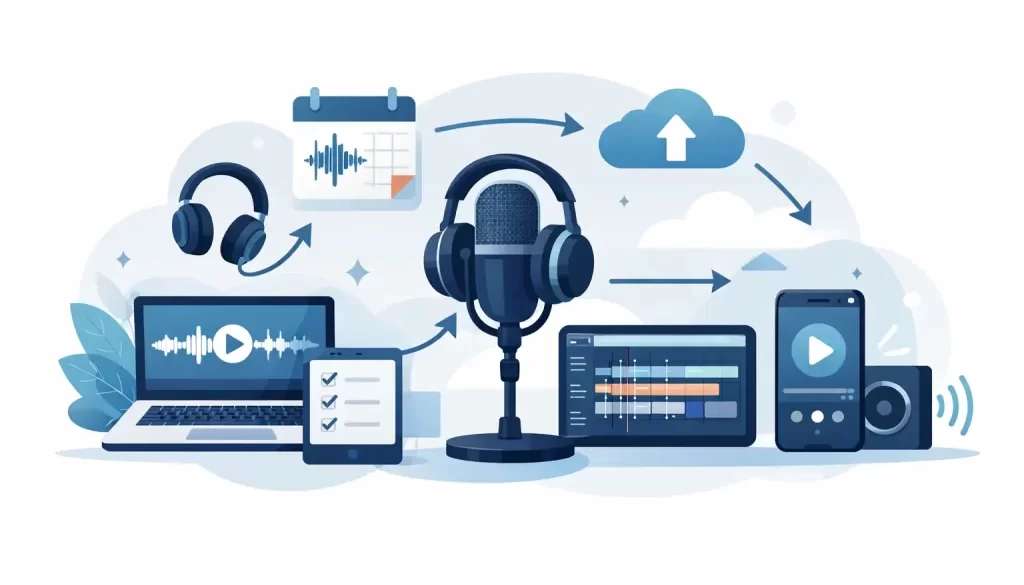
Miss one Wednesday release and most listeners will forgive you. Miss three over two months and they start to assume your show is optional, irregular, or quietly fading away. That is why a podcast workflow for weekly publishing matters so much. It is not just about getting an episode out every seven days. It is about protecting audience trust, maintaining quality, and building a show that sounds commercially credible.
Weekly publishing is where good intentions often meet operational reality. Recording is usually the easy part. The pressure comes afterwards – editing, approvals, artwork, show notes, uploads, scheduling, clips, and the last-minute scramble when something goes wrong. The podcasters who stay consistent are rarely the ones working hardest in the final 24 hours. They are the ones using a workflow that removes avoidable friction.
What a podcast workflow for weekly publishing actually needs to do
A useful workflow is not a bloated production system with endless moving parts. It needs to do three things well. First, it has to make publishing predictable. Second, it has to protect audio quality and brand standards. Third, it has to leave enough margin for real life, because guests reschedule, files corrupt, and hosts get busy.
That balance matters. If your process is too relaxed, quality slips and deadlines move. If it is too rigid, every small issue becomes a crisis. The right setup depends on your format, your team size, and how much post-production your show genuinely needs.
A solo interview podcast can often work comfortably on a one-week cycle with smart batching. A branded show with multiple stakeholders, sign-off stages, and video cutdowns will usually need more lead time. Weekly publishing does not mean doing everything weekly from scratch. It means operating on a rolling schedule where different episodes are at different stages at the same time.
Build the week around deadlines, not intentions
The easiest way to break a weekly schedule is to treat the release date as the only deadline. In practice, your publication date is the final checkpoint, not the working target.
For most shows, a dependable weekly process starts by setting internal deadlines several days earlier than the public release. If your episode goes live on Thursday, your edit should ideally be approved by Tuesday. That gives space for final tweaks, scheduling, metadata checks, and any platform issues.
This is where many shows lose time. They wait for the host to find a spare hour to review the edit, or for a guest to approve a quote, or for someone to write the episode title at the last moment. A proper workflow assigns those jobs to specific windows in the week, rather than leaving them to chance.
A practical weekly rhythm
For a standard weekly show, the structure is often simple. Record one to two weeks ahead where possible. Send files immediately after recording, not at the end of the week. Edit within an agreed turnaround. Review promptly. Schedule early.
That sounds obvious, but the difference between a smooth production cycle and a stressful one is usually speed between handovers. An editor cannot start without files. A host cannot approve without a draft. The episode cannot be scheduled without final assets. Weekly publishing rewards responsiveness as much as creativity.
The stages that deserve real attention
Some parts of the workflow can be streamlined without much risk. Others should never be rushed.
Recording quality is one of them. Good editing can improve clarity, pacing, and listener experience, but it cannot fully rescue poor mic technique, noisy rooms, clipping, or hosts talking over each other for an hour. If your goal is a polished weekly show, the workflow starts before you hit record. That means a reliable setup, a quiet environment, and a short pre-flight check for levels, headphones, internet stability, and backup recording.
Editing is another stage where shortcuts can become expensive. Weekly publishing tempts many podcasters to reduce post-production to the bare minimum. Sometimes that is sensible. Not every show needs heavily sculpted storytelling. But nearly every professional show benefits from manual editing that removes distractions, improves flow, and protects listener retention. Filler words, repetitive tangents, long pauses, audio inconsistencies, and awkward interruptions all affect how your brand is perceived.
There is a trade-off here. The more detailed the edit, the more time the episode requires. That is why the workflow should match the show’s commercial goals. If the podcast supports your business, authority, or monetisation strategy, quality is not a cosmetic extra. It is part of the product.
Show notes, titles, and publishing data
Metadata is often treated as admin. It is more valuable than that. Your title helps win the click. Your episode description sets expectations. Your category, artwork consistency, and platform scheduling affect discoverability and presentation.
This does not mean every episode needs a long content marketing campaign attached to it. It does mean someone should own these tasks clearly. If nobody owns them, they happen late, and late work is usually weaker work.
For weekly publishing, keep the process repeatable. Use a standard structure for titles, descriptions, timestamps, calls to action, and episode assets. Repetition is not laziness here. It is operational discipline.
Why batching matters more than speed
Many podcasters assume consistency comes from working faster. In reality, it usually comes from batching better.
Batching recordings gives you breathing room when a guest cancels or a business deadline takes over. Batching admin tasks helps maintain standards without eating into the rest of the week. Even batching decisions helps. If you already know your episode format, intro structure, naming style, and publishing checklist, you remove dozens of tiny delays.
The strongest weekly shows are rarely produced one episode at a time in isolation. They run as a pipeline. One episode is being recorded, another is being edited, another is awaiting approval, and another is already scheduled. That pipeline protects your release schedule from the inevitable unpredictability of business life.
Where weekly podcast workflows usually break
The weak points tend to be predictable. Files are sent late. Feedback arrives in fragments. There is no agreed turnaround. Guests need approval after recording. The host changes the intro on the day of release. Nobody has final responsibility for publishing.
These are not creative issues. They are workflow issues.
If your show feels chaotic, the answer is not always more software or more automation. Often it is clearer ownership. Who records? Who uploads raw audio? Who edits? Who signs off? Who publishes? Who checks the live episode? If one person is doing all of that, the system needs to be lighter. If several people are involved, the handover points need to be tighter.
When outsourcing makes sense
There is also a point where doing everything in-house stops being efficient. If weekly editing is draining hours from client work, sales activity, or content strategy, the real cost is higher than the editing fee. The same applies if the show goes out with inconsistent sound because post-production keeps getting squeezed between other priorities.
That is where professional support can change the economics of the show. A reliable editor or production partner does more than tidy audio. They create consistency, protect deadlines, and reduce reputational risk. For founders, consultants, authors, and brands, that can be the difference between a podcast that feels like a burden and one that supports wider commercial goals.
Pure Podcasting Ltd works with exactly this challenge in mind: helping podcasters sound polished, stay on schedule, and avoid the quality drop that often comes with weekly release pressure.
A sustainable podcast workflow for weekly publishing
The best workflow is the one you can still follow when the week goes sideways. It should be structured enough to keep standards high, but realistic enough to survive travel, launches, client deadlines, and ordinary human delays.
Aim for a workflow with buffer, not bravado. Record ahead where possible. Keep handovers fast. Protect the parts that shape listener experience most. Standardise the admin. Use human editing when quality and brand perception matter. And if the show has commercial importance, treat production like an investment rather than an afterthought.
A weekly podcast does not need to feel frantic. With the right process, it can become one of the most dependable parts of your marketing – quietly building trust every time an episode lands exactly when your audience expects it.