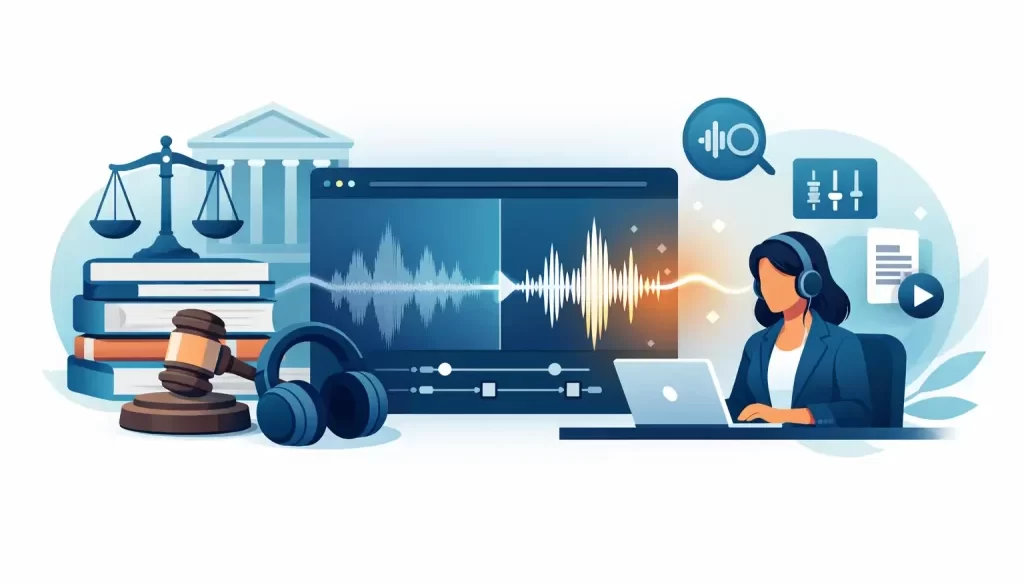
A single misheard word can change the force of a witness statement, a client instruction or a recorded meeting. Legal transcription audio enhancement is therefore not about making a recording sound polished for its own sake. It is about making speech easier to hear while preserving exactly what was said, where uncertainty remains and how the original file was received.
For firms, investigators, in-house teams and businesses handling sensitive recordings, that distinction matters. Audio cleanup can support a faster, more accurate human transcription process. Used carelessly, however, it can introduce doubt about whether a file has been altered or whether a word has been inferred rather than heard.
What legal transcription audio enhancement should achieve
The purpose is intelligibility, not reconstruction. A good enhancement workflow reduces distractions that obscure speech, such as steady air-conditioning, electrical hum, distant traffic, microphone handling and inconsistent levels. It may also make quiet speakers more audible and separate a voice from a noisy background.
It should not make assumptions. If two people speak over one another, no editor can reliably create a clean version of words that were never captured. If a consonant is buried under noise, turning the volume up does not make that consonant certain. A professional process recognises the difference between improved audibility and invented clarity.
That is why the original recording must always be retained, untouched and securely stored. The enhanced copy is a working version to assist review and transcription. It is not a replacement for the source file.
Why clearer audio improves transcription quality
Transcription is demanding even when a recording is clean. Legal audio often adds multiple speakers, unfamiliar names, technical terminology, emotional conversations, telephone quality and intermittent interruptions. When the listener must replay every sentence several times to distinguish words from background noise, turnaround slows and the chance of ambiguity rises.
Careful audio enhancement gives the transcriber a more usable listening environment. Speech can be brought to a consistent level, long silences can be identified more easily and obvious background distractions can be softened. This allows the transcriber to focus on language, speaker attribution and context rather than constantly fighting the recording.
The benefit is particularly strong in lengthy interviews, multi-party meetings and recorded calls. A clear workflow can also help a reviewer locate key passages through sensible timestamps, speaker labels and an agreed transcript format. The audio treatment and transcription should work together, not as disconnected tasks.
The line between enhancement and alteration
This is the central consideration in legal transcription audio enhancement. Enhancement is generally intended to reveal what is already present in the recording. Alteration changes, removes or adds information in a way that could affect interpretation.
For example, reducing a continuous low-frequency hum may make a speaker easier to understand without changing their words. Removing a cough that occurs at the same time as a speaker says something could conceal an interruption or create a misleadingly clean sentence. Aggressive noise reduction can also produce artificial, metallic speech that is harder, not easier, to interpret.
The appropriate level of processing depends on the recording and its purpose. An internal note of a routine business meeting may need a practical, clearly labelled listening copy. Material connected to litigation, an investigation, disciplinary action or regulatory scrutiny requires greater caution, documented handling and advice from the relevant legal team.
A sensible principle is simple: every meaningful processing decision should be capable of explanation. You should be able to say what was done, why it was done and which version of the file was used for transcription.
Keep a clear audit trail
Good handling starts before anyone opens an editing programme. Preserve the original file in its received format and record its source, date, time and any transfer details available. Create a duplicate for enhancement, use clear version names and restrict access to those who need it.
A processing log does not need to be complicated, but it should be specific. It can record the date, operator, software used, adjustments made and the reason for each adjustment. If a transcript refers to an enhanced file, identify that file version. If a word remains unclear, mark it as inaudible or uncertain rather than allowing confidence to creep in through guesswork.
This is also where human oversight earns its place. Automated tools can quickly identify noise profiles or level differences, but they cannot understand the significance of an interruption, an intake of breath, a pause before an answer or a disputed phrase. The final judgement should be made by a skilled listener working to an agreed brief.
A practical workflow for clearer, defensible audio
The most reliable approach is measured rather than aggressive. First, assess the recording without processing it. Note the number of speakers, the main sources of noise, major overlaps, the likely terminology and whether there are sections that require special care.
Next, make a working copy and apply only the processing needed to improve audibility. This may include gentle broadband noise reduction, removal of a constant hum, modest equalisation to bring speech forward and controlled levelling so one speaker is not much quieter than another. Each step should be checked against the original, not accepted simply because a waveform looks more even.
Then provide the transcriber with the appropriate listening copy and clear instructions. These should cover speaker names or labels, required timestamps, verbatim or intelligent-verbatim style, treatment of interruptions and the notation to use for unclear words. Legal accuracy is not improved by a beautiful audio file if the transcription brief is vague.
Finally, carry out quality assurance. A second listener should review difficult passages, proper nouns, numbers, dates and anything material to the purpose of the transcript. Where possible, disputed sections should be checked against both the enhanced version and the original recording.
Common mistakes that undermine useful audio
The first mistake is over-processing. Strong denoising, compression or speech isolation may sound impressive in a short demonstration, but can damage consonants and introduce digital artefacts over a full recording. The best result is often less dramatic than people expect: clearer enough to work from, but faithful to the source.
The second is relying on automated transcription as the final record. Speech-to-text can be helpful for producing a draft or locating a section of a long file. It is less dependable with cross-talk, regional accents, legal terminology, poor telephone lines and names. It should be reviewed by a competent human listener before it is relied upon.
The third is treating confidentiality as an afterthought. Sensitive recordings require controlled file transfer, secure storage, defined access and a clear retention process. Convenience should not override the obligations attached to personal, commercial or legally sensitive information.
The fourth is assuming all recordings need the same treatment. A studio microphone, a smartphone memo, a body-worn device and a conference-call recording each have different limitations. The right approach depends on what the file contains, what must be heard and how the transcript will be used.
When specialist human audio work is worth it
There is a point at which an in-house attempt to clean up a file stops being efficient. If the material is long, the stakes are high or the key speech is obscured by difficult noise, specialist support can save significant review time while producing a clearer record of the work undertaken.
Long-form audio experience is especially valuable here. At Pure Podcasting Ltd, human-led editing is built around attentive listening rather than a one-click automated result. While legal transcription is a specialist service in its own right, the same discipline applies to any sensitive spoken-word recording: protect the original, improve only what can be improved faithfully, and make the final listening copy genuinely useful.
If a recording may be used in a formal legal process, agree the handling and enhancement approach with your legal advisers and transcription provider before work begins. That early conversation can prevent avoidable questions later about provenance, processing and accuracy.
Clearer audio will not solve every gap in a recording. What it can do, when handled carefully, is give every spoken word its best fair chance of being heard.