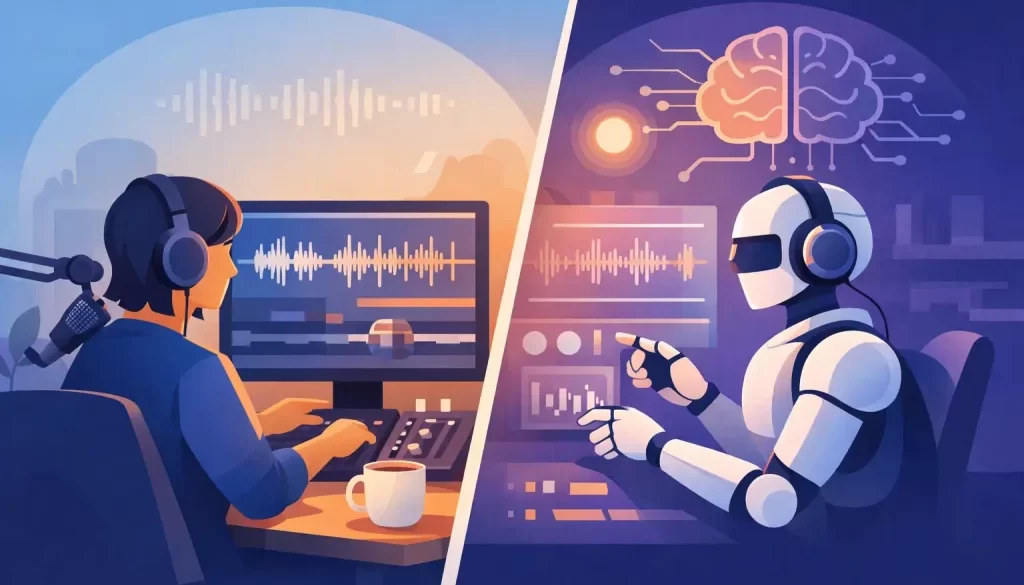
If you have ever listened back to an episode and thought, that sounded fine when we recorded it, you already understand the real issue in the human editor vs AI editing debate. Podcast post-production is not just about removing filler words or levelling audio. It is about protecting your reputation, holding listener attention, and making sure every episode sounds good enough to support growth, trust and, for many shows, commercial results.
AI editing tools have improved quickly. They can tidy audio, remove background noise, shorten silences and automate parts of the workflow. For some podcasters, that is useful. But when your show represents your business, your expertise or your brand, the question is not whether AI can edit audio. The question is whether it can make the right decisions for your audience.
Human editor vs AI editing: what is the real difference?
At a surface level, the difference looks simple. AI editing relies on software rules and automated detection. A human editor listens, judges and shapes the episode with context in mind. In practice, that gap is far more significant than it first appears.
AI is generally good at repeatable tasks. If you want to remove consistent background hum, normalise levels or cut obvious silence, it can save time. That makes it attractive for creators who need speed, are working with limited budgets or are producing internal content where the stakes are lower.
A human editor brings something AI still struggles to replicate: judgement. That includes knowing when a pause adds emphasis, when an interruption should stay because it feels natural, when a sentence needs tightening for pace, or when a speaker’s emotion matters more than technical neatness. Podcast editing is rarely just technical correction. It is editorial decision-making.
Where AI editing works well
It would be unfair to suggest AI has no place in podcast production. It does. For rough cuts, fast internal reviews and basic clean-up, AI can be efficient. It can help solo creators process large volumes of content more quickly, and it can reduce repetitive admin in the post-production stage.
If your show is highly scripted, recorded in a controlled environment and does not depend heavily on nuance, an AI-assisted workflow may be perfectly acceptable. The cleaner the source recording, the better the automated result tends to be.
There is also a cost argument. Entry-level AI tools can look cheaper than professional editing, especially at the beginning. If someone is launching a passion project and simply needs a usable file online, that may be enough for now.
The key point is this: AI is most effective when the editing brief is narrow and the risk of getting it slightly wrong is low.
Where human editing earns its value
The moment your podcast becomes part of your business, the standard changes. A branded show, a founder-led podcast, a thought leadership series or an interview format with guests all create variables that automated editing does not handle consistently well.
A human editor hears the details that influence listener retention. They notice when an answer runs too long before the real point lands. They hear when room tone changes between speakers and becomes distracting. They can smooth awkward transitions, reduce verbal clutter without making the host sound artificial, and preserve the rhythm that makes conversation feel credible.
That matters because listeners do not assess your editing in technical language. They simply decide whether your show feels polished, trustworthy and worth returning to.
For commercial podcasts, that judgement has real consequences. Poor pacing can reduce completion rates. Harsh edits can make a host sound stiff. Unbalanced audio can make a guest interview harder to follow. A careless final mix can weaken the overall perception of your brand, even if the content itself is strong.
A good human editor is not just tidying sound. They are protecting the listening experience.
Human editor vs AI editing on quality and consistency
Consistency is where many podcasters start to see the gap clearly. AI can produce decent results one week and slightly odd ones the next, depending on the recording conditions, the number of speakers and the tool’s interpretation of the audio.
A human editor works to a standard. They learn your voice, your pacing, your audience and your preferences. Over time, they create continuity across episodes, which is vital if you are trying to build a recognisable, professional show.
This is especially important for long-form content. Podcasts are not short clips designed only for quick consumption. They often involve layered conversations, tonal shifts, ad reads, intros, outros, guest dynamics and subtle moments that need handling with care. Long-form audio rewards attention. It punishes blunt automation.
There is also the question of quality control. AI tools process. Human editors review. That difference matters when the final output reflects directly on your business.
Speed, cost and the trade-offs
The strongest case for AI is usually speed and price. In some situations, that is entirely reasonable. If your choice is between publishing something acceptable with AI or not publishing at all, automation may help you stay consistent.
But cheaper is not always more economical. If AI editing leaves behind distracting cuts, unnatural speech patterns or uneven audio, you may spend extra time checking files, making corrections or dealing with the consequences later. That can mean lost time, delayed publishing and a weaker listener experience.
Human editing costs more because it involves expertise, attention and responsibility. You are paying for someone to make decisions, spot issues before they become public and deliver a polished episode that supports your wider goals.
That is why the right comparison is not just price per episode. It is value per episode. If your podcast helps generate enquiries, strengthens authority, supports client trust or opens sponsorship opportunities, quality editing becomes part of the return on investment.
When a hybrid approach makes sense
For some podcasters, the answer is not fully human or fully AI. A hybrid approach can work well when used carefully. AI might handle basic transcription, silence detection or early clean-up, while a human editor manages the final edit, pacing, quality control and polish.
This can be a sensible middle ground for busy teams that want efficiency without giving up editorial standards. The important part is knowing where automation ends and where judgement needs to begin.
Used well, AI can support a professional workflow. Used as a replacement for editorial thinking, it often shows.
Which option is right for your podcast?
If you are running a casual hobby show, testing an idea or producing simple solo content on a tight budget, AI editing may be enough for now. There is no benefit in overcomplicating that.
If, however, your podcast is tied to your brand, your business development or your credibility, human editing is usually the safer and stronger choice. The more visible the show, the more guest-led the format, and the more commercial the objective, the more valuable human judgement becomes.
That is particularly true for podcasters who want more than a cleaned-up file. Many need reassurance, responsiveness and a reliable process. They want someone who notices recurring issues, helps improve recording quality over time and provides the confidence that each episode will be handled properly. Software does not replace that kind of support.
For businesses investing in podcasting seriously, editing should not be treated as a commodity task. It is part of production quality, audience retention and brand perception. Those are not small details. They shape whether your podcast sounds amateur, acceptable or genuinely professional.
At Pure Podcasting, this is exactly why manual editing still matters. Not because automation is useless, but because your podcast deserves more than a generic process. It deserves careful listening, considered decisions and an editor who understands what the episode needs to achieve.
The best choice comes down to what your show is for. If it only needs to exist, AI may do the job. If it needs to impress, retain listeners and support real business outcomes, human editing is still the standard worth paying for.
The real test is simple: when someone hears your podcast for the first time, does it sound like something you rushed out, or something you are proud to put your name to?