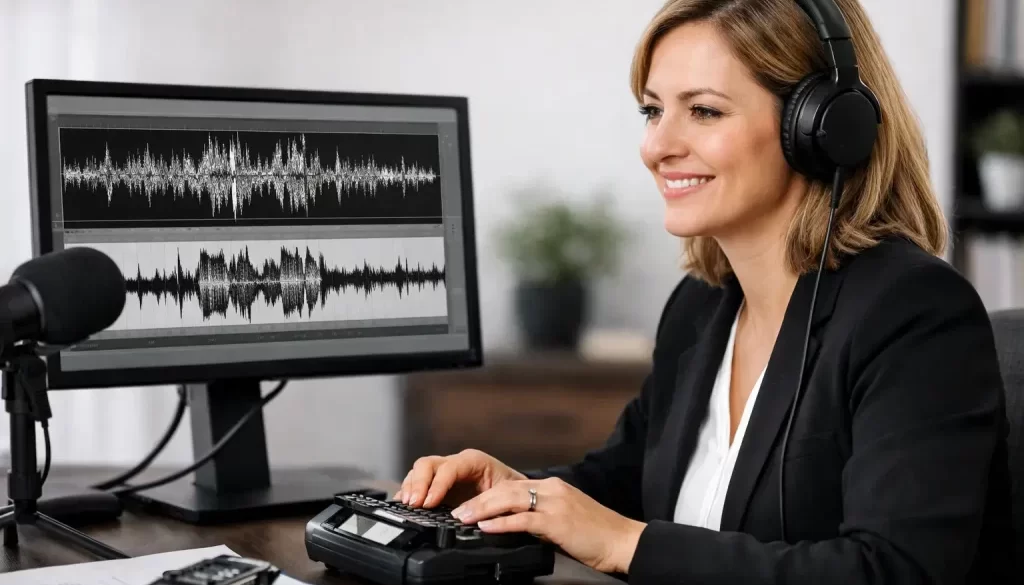
A single unclear sentence can change the meaning of an interview, weaken a client’s confidence in your brand, or leave an editor guessing at a key point. That is why how court reporters handle bad audio is a useful benchmark for business podcast teams. Their job is not to make assumptions sound convincing. It is to produce an accurate record and clearly identify what cannot be verified.
For a business podcast, the stakes may be different, but the principle is the same. Your programme represents your expertise, your people and often your commercial proposition. Good post-production can rescue a surprising amount, yet no responsible producer should promise that every recording can be made perfect.
The court reporting standard: accuracy before appearance
Court reporters and legal transcription professionals work from a simple discipline: they distinguish what was said, what can reasonably be confirmed and what is genuinely unintelligible. They use context carefully, but do not invent missing words simply because a sentence seems likely to end in a particular way.
That discipline matters in podcast production. An editor may be able to remove a cough, reduce air-conditioning noise, balance a quiet guest and tighten a hesitant answer. But if a guest’s key claim is masked by a mobile connection drop-out, overlapping voices or severe distortion, the right response is not to guess and hide the uncertainty behind polished music.
The priority is always the integrity of the final episode. For founders, professional services firms and organisations building authority, credibility is worth more than saving one imperfect sentence.
How court reporters handle bad audio – and what podcasters can learn
The first response to poor audio is usually methodical listening, not aggressive processing. A trained listener will replay the passage, check surrounding speech, consider whether a second recording exists and assess whether another speaker’s response clarifies the point. In a podcast workflow, this could mean referring to the local recording rather than the online call recording, checking a producer’s backup track, or reviewing video footage for visual cues.
Context can help identify a word, particularly where a guest has already used the same technical term earlier in the conversation. It should not be used to put an unspoken claim in somebody’s mouth. A cautious editor treats context as a route to verification, not a licence to reconstruct the interview.
This is especially relevant in regulated, financial, healthcare and legal-adjacent sectors. If the episode includes data, clinical advice, investment commentary, contractual detail or a sensitive public statement, an unclear phrase should be checked with the speaker before publication. The quickest route to release is not always the safest route to a useful, trusted asset.
Separate noise problems from missing-information problems
Not all bad audio is equally serious. Constant background noise, a slightly echoey room or a guest who recorded too quietly may be repairable. Modern restoration tools can reduce hiss, hum and light room noise; careful EQ, compression and level matching can make a conversation more comfortable to hear.
These treatments involve trade-offs. Excessive noise reduction can create metallic artefacts and remove the natural detail in a voice. Heavy processing can make a guest sound distant or synthetic, which is hardly the premium impression a branded podcast should create. The aim is clear, natural communication, not an over-processed result.
A missing-information problem is different. Words lost to packet loss, a clipped microphone, people speaking over each other, a passing siren or a badly distorted track cannot necessarily be restored. Software may make an obscured voice more audible, but it cannot reliably recover audio that was never captured. In those moments, experienced production judgement is more valuable than a one-click tool.
Use the best available source before editing
Remote recording platforms often create separate local tracks for each participant. These are generally far superior to the compressed audio heard on a live video call, particularly when one person’s internet connection is unstable. If a guest’s live feed sounds poor, it does not automatically mean the recording is unusable.
A professional producer will first establish what sources exist: local isolated tracks, a platform backup, the host’s recording, the guest’s own recording and, where appropriate, video. Each source should be checked before any major editorial decisions are made.
This is why recording design is part of production quality, not an administrative detail. A clear process before the interview can prevent a difficult rescue job afterwards. It also gives guests confidence that a brief technical issue will be handled calmly rather than becoming their problem.
Decide when to repair, clarify, cut or re-record
The right solution depends on the importance of the affected material. If an unclear phrase is a minor aside and removing it does not change the flow or meaning, a clean edit may be best. If the phrase contains a central insight, a statistic or a call to action, it may be worth asking the guest to supply a replacement line.
A short re-record is often easier than clients expect. The producer can send the exact wording or a clear prompt, ask the speaker to record it in a quiet space, and blend the replacement naturally into the episode. If the guest’s tone, microphone and room are significantly different, the edit may still be noticeable, so this approach needs careful judgement.
Sometimes a host-recorded clarification is more appropriate. For example, if a guest’s audio failed while giving a web address, event date or product detail, the host can state the confirmed information cleanly. That is preferable to leaving listeners uncertain or risking a misleading reconstruction.
Where none of these options protects the meaning, cut the section. It can feel painful to lose a good moment, especially after a busy guest has given their time. However, publishing audio that listeners cannot understand creates a worse experience and may undermine the authority the podcast was intended to build.
Build a process that prevents bad audio reaching the edit
For business podcasts, prevention begins well before the record button is pressed. Guests should receive straightforward recording guidance, including the value of headphones, a quiet room, notifications switched off and a reliable microphone or headset. This need not make the experience burdensome. Good support makes guests feel prepared and looked after.
The host also needs a disciplined interview approach. Avoid speaking over guests, leave a brief pause after questions and repeat vital names, numbers or acronyms when necessary. If a guest’s answer drops out live, ask them to repeat it immediately. It is far easier to fix a problem in the moment than to recover it days later in post-production.
A dependable production workflow should include a technical check, a recording backup plan and a review stage before publication. For agencies providing a podcast service under their own brand, this is particularly valuable. Reliable behind-the-scenes processes protect both the client relationship and the agency’s reputation without adding pressure to account teams.
Bad audio is also an editorial decision
Audio quality is not merely a technical matter. It affects retention, comprehension and the perceived value of your content. Listeners will tolerate the natural texture of a remote conversation when the ideas are strong and the voices are clear enough to follow. They are less forgiving when they have to strain to understand a thought leader explain the very expertise they came to hear.
That does not mean every corporate podcast needs a studio or that remote interviews are a compromise. Remote production can be efficient, flexible and highly polished when it is planned properly. It does mean the format needs an experienced person who can make sensible calls when recording conditions are imperfect.
After producing thousands of episodes, the most useful production rule remains straightforward: enhance what is genuinely there, verify what matters, and never let a polished edit pretend to be an accurate record. The right support gives your team the confidence to focus on the conversation, while a dedicated producer protects how it sounds and what it says.