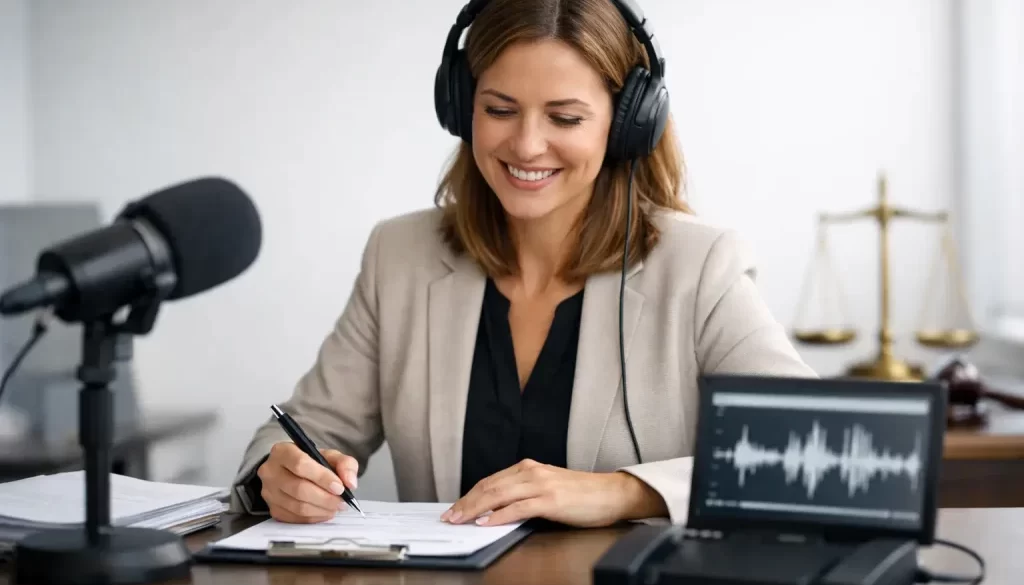
A single missed word can alter the force of a witness statement, obscure an objection or create unnecessary time and cost when a hearing is reviewed. Audio quality court transcription accuracy is therefore not a technical nicety. It is a requirement for producing a dependable record of what was actually said.
For legal teams, court services and organisations recording formal proceedings, poor sound creates a chain of problems. Transcribers spend longer resolving unclear passages, speakers may be misidentified, and the final document can contain more qualifications, gaps and requests for clarification. Good recording practice does not replace skilled transcription or formal court reporting. It gives those professionals the evidence they need to work accurately and efficiently.
Why audio quality affects the legal record
Transcription is an interpretation of recorded speech. Where a recording is clean, a trained transcriber can hear the words, distinguish speakers and preserve the rhythm of questioning, interruption and response. Where it is muffled, distorted or dominated by room noise, even an experienced professional may be forced to make a best judgement or mark a passage as inaudible.
That distinction matters more in legal settings than in a typical business conversation. Names, dates, figures, technical terms and short words such as “not”, “now” and “no” can carry significant weight. The same is true of overlap. A judge, counsel and witness may speak at almost the same moment, and a low-quality recording can turn a meaningful exchange into an unintelligible blur.
Audio quality also affects turnaround. A one-hour hearing is not necessarily one hour of transcription work. If the source audio is clear and well organised, the process is faster to complete and simpler to check. If there are echoing rooms, distant microphones and intermittent drop-outs, the same recording may require repeated listening, research and follow-up questions.
The audio issues that cause transcription errors
The most damaging problems are usually mundane rather than dramatic. A microphone positioned too far from a speaker captures the room before it captures their voice. This produces echo, reduces clarity and makes quiet speech hard to recover. Placing one omnidirectional microphone in the middle of a large room may seem convenient, but it rarely provides the separation needed for a reliable multi-speaker record.
Background noise is equally disruptive. Air conditioning, traffic, paper handling, keyboard taps, chairs and corridor conversations can sit in the same frequency range as speech. Noise reduction can improve a recording, but it is not magic. Applied too aggressively, it can make voices sound artificial and remove the very consonants needed to distinguish words.
Level control is another common weakness. If a speaker suddenly raises their voice, the recording can clip. Once audio has distorted at the point of capture, it cannot be restored convincingly in post-production. At the other extreme, recordings made at very low levels need substantial amplification, which raises the noise floor along with the speech.
Connection quality matters for remote hearings and interviews. Video-call platforms compress audio to prioritise a stable conversation, not necessarily a forensic-quality archive. Participants using laptop microphones from reflective rooms, unstable internet connections or Bluetooth headsets introduce further variables. A call may sound acceptable live yet leave a recording with artefacts, missing syllables or inconsistent volume.
Audio quality court transcription accuracy starts before recording
The most valuable decisions happen before anyone enters the room or joins the call. First, establish what the recording must achieve. Is it an internal fact-finding meeting, a formal interview, an arbitration, a hearing or material that may later be reviewed by legal advisers? The higher the consequence of an error, the less sensible it is to rely on improvised equipment and a single unmonitored recording.
Each principal speaker should ideally have a dedicated microphone or a clearly defined capture position. In a courtroom or boardroom, this may mean fixed microphones at the bench, counsel positions and witness location. For a remote participant, a wired USB microphone or professional headset is usually more dependable than an open laptop mic.
A short sound check should confirm three things: that every speaker is audible, that no channel is peaking and that the recording is being captured where expected. Ask participants to say their name and speak at a normal level. It is also sensible to test the exact platform and recording workflow before a significant session rather than discovering limitations when the event is under way.
Where practical, record a backup. This may be a separate recorder, an independent platform recording or isolated tracks for remote participants. The right approach depends on the privacy requirements, procedure and permissions involved, but relying on one unverified file is an avoidable risk.
Record separate tracks where possible
Separate audio tracks are especially useful when several people speak. They allow an editor or transcription provider to balance a quiet voice without raising everybody else, minimise intermittent noise on an individual channel and identify who spoke during overlap. They also provide clearer evidence when a participant’s connection suffers a local fault.
A mixed recording still has value, particularly when a simple, authorised setup is required. However, once voices are blended together, there is far less room to improve clarity later. For important proceedings, separate tracks offer a meaningful safeguard.
The role of professional audio post-production
Post-production can make a recording easier to listen to and transcribe. Careful editing can reduce consistent background noise, even out excessive level differences, improve speech intelligibility and remove avoidable distractions. It can also ensure files are sensibly named, securely delivered and easy for the transcription team to navigate.
There are limits. Audio restoration should support the original record, not alter it. Removing a repeated cough is one thing; changing the content, sequence or meaning of a spoken exchange is entirely another. Any legal recording workflow should have clear rules on what processing is permitted, retain the original source file and document how the working copy was created.
This is where an experienced production partner adds practical value. Professional audio work is not simply pressing an automated enhancement button. It involves listening for faults, understanding the consequences of processing choices and knowing when a problem cannot honestly be fixed. For agencies or organisations managing regular recorded interviews, hearings or expert discussions, a dependable workflow is more useful than a last-minute rescue attempt.
Better source audio still needs human verification
Clear audio increases accuracy, but it does not make transcription infallible. Legal terminology, unusual names, acronyms and technical evidence require context. A quality assurance process should include access to correct spellings, a list of attendees and, where appropriate, reference materials that help the transcriber distinguish specialist language.
Speaker identification deserves particular care. Labels such as “Speaker 1” may be acceptable for some internal records, but a formal transcript often needs verified names and roles. If participants introduce themselves at the beginning and the recording is properly logged, this task becomes less uncertain.
Review is also essential. The appropriate level depends on the purpose of the transcript. A rough working transcript for internal research has different requirements from an official record used in litigation or regulatory matters. Legal teams should agree the required standard, identify who has authority to resolve queries and make sure corrections are tracked rather than silently overwritten.
A practical standard for meetings, hearings and interviews
For routine high-stakes recordings, consistency is more valuable than elaborate equipment. Use suitable microphones close to speakers, monitor the recording, capture a backup where approved, retain the unedited original and provide the transcription team with accurate context. These measures reduce uncertainty at every stage.
For remote sessions, give contributors clear instructions in advance. Encourage a quiet room, headphones where appropriate, a stable wired connection if available, and a microphone positioned close to the mouth but out of the direct breath path. Ask them not to share a room with another remote participant using an open microphone, as this can create echo and make speaker separation difficult.
A professional producer can help design and manage this process, particularly where an organisation runs recurring recorded sessions or needs a discreet extension to its internal team. Pure Podcasting applies the same disciplined approach to recording preparation, file management and audio quality that helps business conversations sound clear and credible. However, formal court transcription and legal certification should always remain with the appropriately qualified legal transcription or reporting provider.
The best time to protect a reliable transcript is before the first question is asked. Clear capture, sensible safeguards and skilled human review give every word the best possible chance of being heard as it was spoken.