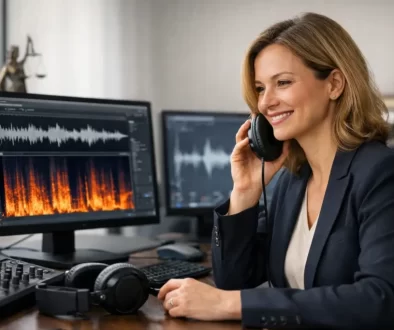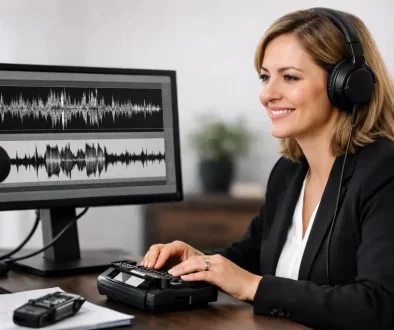
A listener turns up your interview on the drive to work, then gets hit by a much louder advert or has to reach for the volume control when your next episode begins. That small irritation can make a carefully produced business podcast feel inconsistent. This podcast loudness standards guide explains the measurements that matter, the sensible targets for spoken-word shows, and why good mastering is about more than making audio louder.
For a founder, marketing team or agency, loudness is a brand issue. Consistent audio signals care, makes conversations easier to follow and helps your show sit comfortably alongside the professional podcasts your audience already hears.
What podcast loudness standards actually measure
Loudness is not the same as peak level. A waveform can show peaks close to 0 dB while still sounding comparatively quiet, because the occasional loudest moment tells us little about the average perceived level of speech.
The measurement most useful for podcast production is LUFS – Loudness Units relative to Full Scale. Integrated LUFS measures the perceived loudness across a whole file. It provides a far more reliable basis for matching one episode to the next than peak meters or older RMS readings.
True peak, measured in dBTP, is the other figure to watch. It estimates peaks that can occur when the file is encoded or played back, even if the original digital samples did not appear to exceed the limit. Leaving true-peak headroom reduces the risk of unpleasant distortion on consumer devices and streaming platforms.
A third consideration is loudness range, often shown as LRA. It describes how much the programme moves between quieter and louder passages. A wide range can suit a carefully crafted documentary, but it can make a business interview hard to follow in a car, open-plan office or while walking. The right range depends on the format, not a blanket rule.
Podcast loudness standards guide: the practical targets
For most stereo spoken-word podcasts, a sensible professional delivery target is -16 LUFS integrated, with a maximum true peak of -1 dBTP. For a genuinely mono programme, -19 LUFS integrated is the conventional equivalent. These are widely used podcast delivery targets because they provide a comfortable, dependable listening level without pushing voice processing too far.
They are targets, not a licence to force every file into the same shape. A panel discussion with four remote guests, a narrative series with quiet archive clips and a concise solo leadership briefing will each need different editorial and mixing decisions before the final loudness measurement is applied.
It is also worth separating podcast convention from music-platform normalisation. Some services use playback normalisation and may turn material up or down to meet their own listening targets. That does not mean a business podcast should be mastered like a commercial music release. Delivering a clean, controlled spoken-word master at an appropriate podcast level gives platforms a sensible source file to work from.
Avoid treating 0 dBFS as a delivery goal. It is the digital ceiling, not the desired loudness. A file can touch that ceiling and still sound weak, harsh or fatiguing. Worse, aggressive limiting to achieve a visibly dense waveform often removes the natural emphasis and breathing space that makes a host sound credible.
Why consistency matters more than chasing volume
Listeners rarely praise a programme because it is loud. They do notice when a guest disappears beneath room noise, the host is suddenly much brighter or louder than the previous episode, or the music sting feels like an interruption rather than part of the production.
Consistency supports retention. If listeners know they can press play without adjusting their device, they are more likely to stay with a 30-minute expert conversation, absorb your message and return for the next episode. For branded podcasts, that reliability has a direct commercial value: it protects the authority you have invested in building.
It matters across the back catalogue too. Many organisations improve their recording setup over time, which is positive, but the shift should not leave older and newer episodes feeling like entirely different shows. A production workflow that checks loudness, tone and level at every stage creates continuity even as formats, hosts and guests evolve.
For agencies delivering programmes under their own brand, predictable technical standards also reduce review cycles. Clients may not ask for a LUFS report, but they will notice a release that sounds polished and stable beside the rest of their communications.
Getting to the target without damaging the conversation
Loudness is the final result of several decisions, beginning before anyone speaks. Good microphone technique, sensible input gain, a quiet room and headphones for remote guests solve problems that no mastering chain can fully repair. If a speaker is clipping on the recording or is 30 centimetres further from the microphone than the host, simply turning them up will also turn up distortion, echo and background noise.
During editing, the producer should first address obvious level differences between speakers, remove distracting noises where appropriate and make the conversation flow naturally. Clip gain or automation is often more transparent than relying solely on a compressor to rescue an uneven recording.
Compression can then gently narrow excessive differences between soft and loud speech. Used well, it keeps a guest intelligible without making them sound flattened or overly processed. Equalisation can improve clarity, while careful noise reduction may reduce distractions from remote recording environments. Each process has a trade-off. Too much noise reduction can create a watery, artificial voice; too much compression can make breaths, mouth sounds and room tone overly prominent.
A limiter placed at the end of the chain protects the true-peak ceiling. It should catch occasional peaks rather than continually work hard. Finally, a loudness meter verifies the integrated LUFS and true-peak result across the complete episode. Measuring only a short extract is not enough, particularly where an episode includes music, trailers or a quiet closing section.
Music, adverts and video create extra decisions
Music changes the calculation because it can raise the integrated measurement quickly, especially in a short episode. A loud opening theme may make the final LUFS figure appear correct while the spoken content itself remains too quiet. The answer is not necessarily to remove all musical dynamics, but to balance the programme as listeners experience it.
Adverts and sponsor messages deserve their own attention. They should be intelligible and professionally levelled, but a sudden jump in density can feel intrusive. Matching their perceived level and tonal balance to the surrounding programme protects the listening experience and, by extension, the value of the sponsorship.
Video podcasts introduce another layer. The audio master still needs to meet sensible podcast loudness practice, but video platforms can apply different normalisation behaviour. A producer should check the finished file in the intended format rather than assume an audio-only master will always translate perfectly after video export, encoding and upload.
Common loudness mistakes in business podcasts
The most frequent mistake is mastering by eye. A large waveform may look reassuring, but it does not tell you whether guests are understandable, whether sibilance is uncomfortable or whether the show sits naturally on headphones.
Another is setting a target once and forgetting it. A change of host, microphone, recording platform, editor or music package can alter the programme’s perceived level. Quality control should be part of the release process, not something reserved for a launch.
Finally, many teams mistake loudness matching for quality control. A meter cannot decide whether a chair squeak should be edited out, whether a pause carries meaning or whether a guest needs level automation during a valuable but softly spoken answer. Those are editorial and technical judgements that benefit from an experienced producer listening to the full story.
Build loudness control into your production workflow
The most efficient approach is to agree a delivery specification at the start, then apply it consistently across recordings, edits, approval masters and published files. Keep the target documented for everyone involved, including any white-label production partner, and leave time for a final monitored listen rather than approving from a waveform or meter alone.
For most business shows, -16 LUFS stereo, -19 LUFS mono and -1 dBTP true peak provide a sound starting point. The real value comes from the production work around those numbers: well-recorded voices, thoughtful editing, controlled dynamics and dependable checks before publication.
At Pure Podcasting, this is treated as part of making each client sound their best, not as a last-minute export setting. If your programme needs to build authority with demanding listeners, a dedicated producer can set the standards, manage the detail and ensure every episode arrives with the same confident, professional presence.