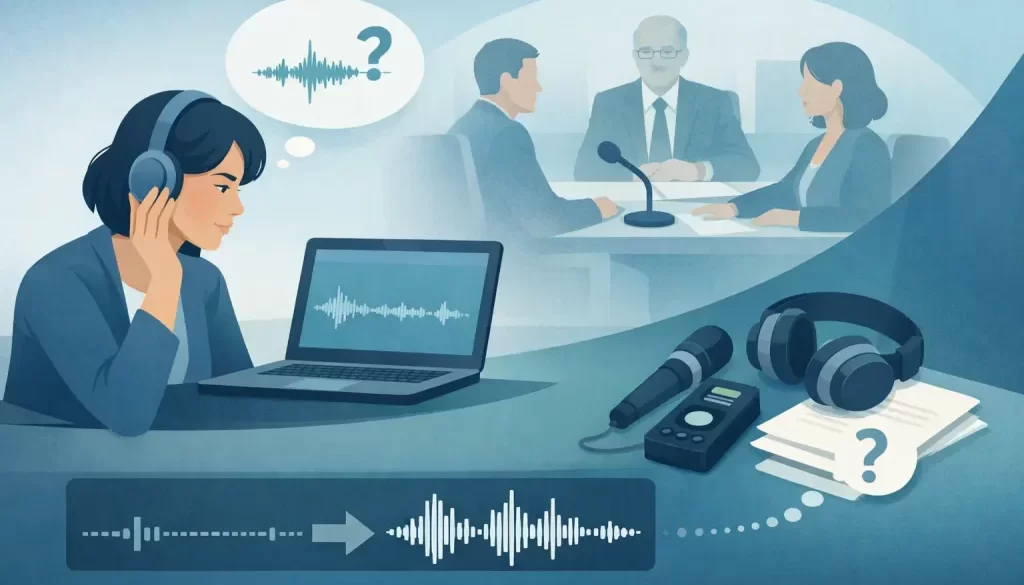
A deposition is not a second take. When deposition audio is too quiet to transcribe, the issue is more than an inconvenience for the person preparing the transcript. It can slow a case, increase review time, create disagreement over what was said, and put unnecessary pressure on a recording that may already be the only reliable record of testimony.
The right response is not simply to turn the volume up. Low-level speech brings background noise up with it, and aggressive processing can make words sound clearer while quietly changing consonants, timing or context. For legal material, that is a serious risk. The goal is to recover intelligibility without inventing certainty that the recording cannot support.
Why quiet deposition audio is difficult to recover
Quiet audio is often caused by a witness sitting too far from the microphone, a poorly placed boundary mic, an incorrect recorder input level, weak remote-call audio, or a speaker whose voice naturally drops at the end of sentences. In a multi-person deposition, there may also be major level differences between counsel, the witness and an interpreter.
The challenge is the signal-to-noise ratio. If the spoken voice is only slightly louder than air conditioning, paper movement, keyboard taps or a distant road, there is limited usable speech to work with. Raising gain makes everything louder. Noise reduction may suppress the room sound, but if applied too heavily it can leave speech watery, clipped or difficult to trust.
This is why a clean but quiet recording is often more recoverable than a loud recording with distortion. A recording that has clipped at the source has already lost information. A recording with excessive reverberation may preserve the words, but makes them overlap in a way software cannot always separate.
First steps when deposition audio is too quiet to transcribe
Before attempting a full transcription, preserve the original file exactly as received. Make a working copy and record basic details such as the file name, date, source device, format and any conversion made. Legal recordings should not be treated like ordinary content files where convenience matters more than traceability.
Then listen critically on decent closed-back headphones rather than laptop speakers. Check whether the problem affects the whole file, one speaker, one channel or only certain sections. A witness may be audible in the left channel while the other participants are on the right, for example. What appears to be a quiet recording can sometimes be a channel-routing issue.
A sensible initial assessment considers four questions:
- Is speech present but low in level, or buried beneath noise?
- Is the issue consistent, or does it vary by speaker and timecode?
- Has the audio distorted, clipped or dropped out?
- Is there another recording source, such as a conference platform capture or backup recorder?
If there is a backup source, do not assume one file must replace the other. A secondary recording may be useful for confirming a difficult phrase, identifying a speaker, or filling a brief interruption. Keep sources clearly labelled and do not merge them without retaining the originals.
What professional audio enhancement can do
A careful editor can usually improve the listening experience through measured gain staging, channel balancing, gentle equalisation and controlled noise reduction. The workflow should be iterative. Improve a small section, compare it with the original, and check whether the speech is genuinely clearer rather than merely brighter or louder.
Equalisation can help bring forward the frequencies that carry speech intelligibility, particularly where a voice sounds muffled. Compression can reduce dramatic differences between a quiet witness and a louder questioner. Selective noise reduction may reduce a steady hum or fan noise. In some cases, manual editing between speech passages makes the file easier to follow without altering the spoken content.
For long-form audio, human judgement matters. An automated tool may treat a quiet syllable as noise, remove the end of a word, or attempt to recreate speech that is not actually there. That might be acceptable for a casual social clip. It is not an appropriate standard for evidence-sensitive material.
The trade-off is straightforward: stronger processing can produce a more immediately listenable file, but it may also introduce artefacts. A professional should therefore retain an unprocessed version, document the treatment used, and provide an enhanced reference copy only where the purpose and handling requirements allow it.
When the recording cannot support a reliable transcript
Not every file can be rescued. If a word is below the noise floor, masked by another person speaking, missing due to a digital dropout, or distorted beyond recognition, no responsible editor or transcriptionist should guess.
A reliable transcript needs a clear convention for uncertainty. Depending on the required format, this may mean marking a passage as inaudible, identifying an uncertain word, or referring the issue for review against another authorised source. The key point is that enhancement should help a qualified listener hear what is already recorded. It should not turn an assumption into a statement of fact.
Be cautious with automatic transcription in particular. Speech-to-text systems can be useful for producing a rough working draft from reasonably clear audio, but they are vulnerable to names, legal terminology, accents, overlapping speech, poor microphones and low-volume testimony. Their confidence can sound persuasive even when the wording is wrong.
For a formal record, use the processed audio as an aid to human review, not as a substitute for it. If the recording is central to a matter, seek advice from the appropriate legal, court-reporting or forensic audio professional on admissibility, disclosure and documentation requirements.
A better workflow for quiet multi-speaker recordings
The most efficient route is usually to separate technical recovery from transcription quality control. First, assess the original and identify the specific faults. Next, produce a carefully enhanced listening copy where that is justified. Then transcribe with speaker labels, time references for unclear passages and a second-pass review of difficult sections.
For a remote deposition, it is especially helpful to compare platform audio with each participant’s local recording, if available. Local tracks are normally clearer because they do not contain the same internet compression and connection interruptions. They also allow an editor to balance speakers independently rather than trying to repair everyone from one compressed call recording.
Where time is limited, prioritise the passages that matter most. Opening formalities may be easy to restore later, while a disputed answer, a qualification to a statement, or a reference to a document may need immediate, careful review. This keeps costs and turnaround proportionate without compromising the parts that carry legal significance.
How to prevent unusable deposition recordings
Prevention starts before anyone speaks. Use a dedicated microphone close to each primary speaker where possible, monitor through headphones, and make a short test recording in the actual room or call setup. Ask each person to speak at a realistic level, including the quieter witness, rather than relying on the voice of the person setting up the equipment.
Record a backup whenever the circumstances permit. For in-person sessions, that might mean a second recorder placed independently. For remote sessions, it can mean a platform capture alongside local recordings. Confirm that all participants understand the recording arrangements and that consent, privacy and procedural requirements have been addressed.
Avoid relying on a single microphone in the middle of a large room. It may seem tidy, but distance magnifies room echo and makes a soft-spoken witness difficult to recover. Keep mobile phones away from microphones, minimise paper handling near the recorder, and pause when an unavoidable noise interrupts an important answer.
The same principles apply to any long-form spoken recording: clear capture at source is cheaper, faster and more dependable than repair afterwards. Pure Podcasting Ltd sees this regularly in high-stakes interviews and business-led shows. Good editing can improve a flawed file considerably, but careful microphone placement and monitoring protect the message before post-production begins.
If you are facing a quiet deposition recording now, preserve the original, resist heavy-handed fixes, and have the file assessed before anyone relies on an automated transcript. A measured human review gives the recording its best chance of being heard accurately, while keeping the limits of the evidence clear.