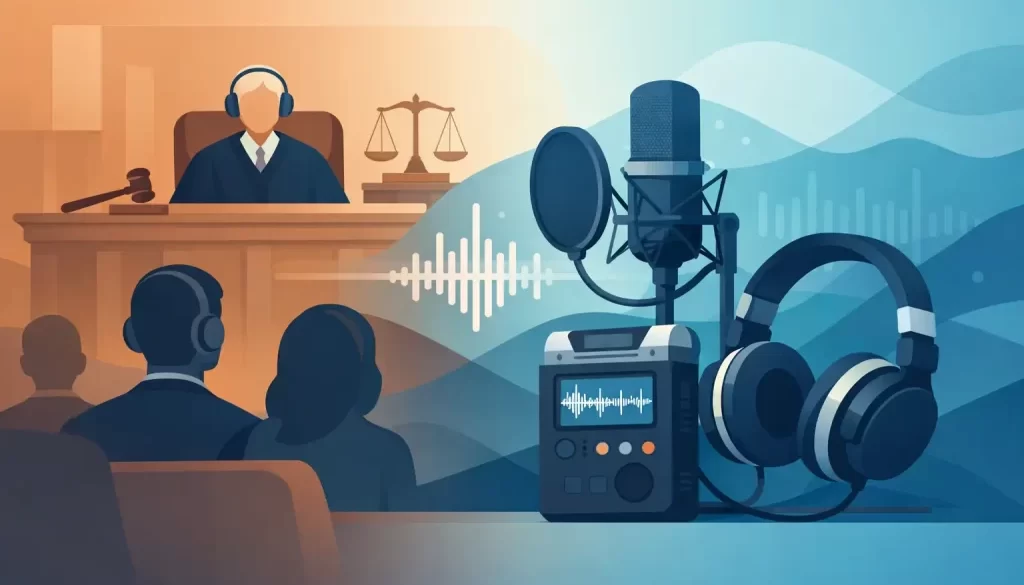
A single muffled answer can change the meaning of a transcript. In a legal setting, that is not a minor production issue. Clean court audio affects accuracy, fairness, record-keeping and, in some cases, the outcome of what follows. When the recording is unclear, every stage after that becomes harder – transcription takes longer, disputes increase, and confidence in the record starts to weaken.
For courts, tribunals, hearings and legal interviews, audio quality is not about polish for its own sake. It is about preserving speech exactly as it was said, with enough clarity that nobody has to guess. That sounds obvious, but in practice it is where many recordings fall down.
What clean court audio actually means
Clean court audio does not mean sterile, studio-perfect sound. Courtrooms are live environments with movement, papers, shifting chairs, distance from microphones and multiple speakers talking at different volumes. The goal is not perfection. The goal is intelligibility.
That means voices are clear enough to follow without strain, background noise is controlled rather than dominant, and each speaker can be distinguished when the recording is reviewed later. If a judge, clerk, barrister, witness or defendant sounds buried beneath room noise, the recording may still exist, but its usefulness drops quickly.
This is where people often confuse volume with quality. Turning everything up does not create clarity. In fact, it can make noise, echo and mic handling more obvious. Clean audio comes from a combination of good capture, careful processing and human judgement during editing or review.
Why court recordings fail more often than people expect
The biggest issue is usually the room itself. Courtrooms were not designed as recording studios. They often have hard surfaces, high ceilings and multiple sound sources. That creates reflections and reverb, which blur speech and make consonants harder to catch.
Microphone placement is another common problem. If a microphone is too far from the speaker, it captures more room than voice. If several people share a badly positioned mic, one speaker may sound acceptable while another is barely audible. This becomes especially difficult during exchanges where speakers interrupt or speak quickly.
Then there is inconsistency. One person speaks directly towards the microphone, another turns away, another covers their mouth, and another speaks quietly from the back of the room. Even with decent equipment, that variation can produce an uneven recording that is technically usable but inefficient to work with.
Administrative pressure plays a part too. In many environments, the priority is simply to make sure something is recorded. That is understandable. But there is a difference between capturing audio and capturing it well enough to support accurate downstream use.
The real cost of poor court audio
Bad audio creates delay. Transcribers need more time. Reviewers replay sections repeatedly. Clarification requests increase. If multiple people need to verify what was said, labour costs rise quickly.
There is also a reputational issue. Where legal and quasi-legal proceedings rely on an audio record, poor clarity can make the whole process feel less dependable. Even if the system is procedurally sound, weak recordings can undermine trust in the documentation around it.
For organisations handling hearings internally, such as regulatory bodies, disciplinary panels or corporate investigations, the risk is similar. If audio cannot be followed confidently, the burden shifts to notes, memory and interpretation. That is a poor position for any professional body to be in.
How to improve clean court audio at the source
The strongest results nearly always start before recording begins. If the original capture is weak, post-production can help, but only to a point.
Microphone choice matters, but placement matters more. A modest microphone in the right position will often outperform a better one placed badly. Speakers should be as close as practical to the pickup point without making the setup intrusive. If the space allows, separate microphones for key positions can dramatically improve clarity.
Monitoring is often overlooked. Someone should actually listen during setup, ideally through headphones, rather than assuming levels are fine because meters are moving. Meters do not tell you whether a room is echoing badly or whether a quiet speaker is dropping below useful clarity.
It also helps to control what can be controlled. That may mean reducing paper shuffling near microphones, positioning equipment away from fans or air handling noise, and making sure participants know to speak clearly and avoid talking over one another where possible. These sound like small points, but together they make a substantial difference.
Where editing helps and where it cannot
Post-production can improve clean court audio, but it is not magic. A skilled editor can reduce steady background noise, even out levels between speakers, remove some distractions and make speech easier to follow. Human editing is especially valuable where nuance matters, because a trained editor can make careful decisions about what to reduce and what must remain untouched.
That said, not every problem is fixable. Severe overlap between speakers, clipped recordings, heavy distortion and extreme reverberation are difficult to recover cleanly. This is why an experienced, manual approach matters more than blanket automated processing. Over-processed legal audio can sound cleaner at first glance but lose important speech detail in the process.
For sensitive material, that trade-off matters. The point is not to create a pleasant listen. The point is to preserve intelligibility without altering the meaning or character of what was said.
Why human judgement matters in legal audio
Automated tools have their place, particularly for speeding up repetitive tasks. But legal recordings are rarely straightforward. Speakers have different accents, levels and pacing. Some sections are quiet but crucial. Others contain hesitation, emotion or interruption that needs to remain audible because it forms part of the record.
A human editor can recognise when a pause should stay, when a rustle can go, and when noise reduction is starting to damage the voice itself. That judgement is the difference between audio that is merely processed and audio that is genuinely usable.
This is one reason service-led editing remains valuable for high-stakes recordings. Whether the end use is archiving, transcription or internal review, someone needs to make deliberate choices rather than applying the same treatment to every minute of sound.
Clean court audio and transcription accuracy
Transcription quality is closely tied to audio quality. When speech is clear, transcripts are faster to produce and require fewer corrections. When audio is patchy, uncertainty creeps in. Words are marked as inaudible, names are guessed, and context has to do too much of the work.
Accents, specialist legal terminology and overlapping speech already make transcription demanding. Add room echo or inconsistent levels, and the margin for error increases. Clean court audio does not remove every challenge, but it gives transcribers a fair chance to produce an accurate record the first time.
For organisations managing ongoing hearings or case-related content, this has a practical commercial angle too. Better source audio reduces friction, saves time and supports a more dependable workflow. Quality at the start tends to cost less than correction at the end.
A practical standard worth aiming for
Perfect silence is unrealistic in a courtroom. What matters is whether the recording can be understood consistently, reviewed efficiently and trusted as a record. If listeners need to strain, replay or guess, the standard is not high enough.
A sensible benchmark is simple. Each primary speaker should be intelligible without excessive effort. Background noise should not compete with speech. Level changes should be controlled enough that listeners are not constantly adjusting volume. And any editing applied should support clarity, not reshape the reality of the exchange.
That standard is achievable, but it usually requires more care than people expect. Equipment helps, process helps, and experienced editing helps most when the source has been captured thoughtfully.
At Pure Podcasting, we see the same principle across every serious audio project: when clarity affects trust, shortcuts become expensive. Court recordings are a clear example of that. If the audio matters later, it needs to be handled properly now.
Clean court audio is not a luxury layer added after the fact. It is part of the record itself, and it deserves to be treated that way from the very first word.