A founder who publishes a poor-sounding podcast rarely gets a second chance. Listeners will forgive the odd rough edge if the insight is exceptional, but they will not stay long if the audio is distracting, the pacing drags, or every episode feels inconsistent. That is why podcast editing for founders is not a technical afterthought. It is part of how your business is heard, judged and remembered.
For founders, a podcast often sits much closer to revenue than people realise. It can support authority, build trust with prospects, nurture existing clients and create opportunities for partnerships, speaking and sales. When the production feels amateur, all of that becomes harder. When it feels polished, clear and professionally handled, your message has a far better chance of landing.
Why podcast editing for founders matters more than it does for hobby shows
A business podcast carries different pressure from a casual chat show. If you are a founder, your voice is tied to your company, your expertise and your commercial reputation. Prospective clients may discover you through an episode before they ever visit your website or speak to your team. Investors, collaborators and media contacts may do the same.
In that context, editing is not simply about removing a few ums and ahs. It shapes whether you sound concise, credible and worth listening to. It also affects listener retention. A strong edit keeps the conversation moving, removes dead space, smooths awkward transitions and protects the energy of the episode. People stay longer when the experience feels intentional.
There is also a time cost that founders cannot ignore. Recording a 40-minute episode is one task. Sorting out microphone issues, levelling voices, cutting repetition, cleaning distractions and preparing a finished file is another. The hidden workload sits in post-production, and it expands quickly once a show becomes regular.
What good podcast editing actually includes
Many founders assume editing means basic cleanup. In practice, the standard required for a commercially credible show is broader than that.
At the most essential level, good editing removes obvious distractions such as mouth clicks, long pauses, false starts, background noise and repeated lines. It balances levels so the host and guest sit comfortably together, and it produces audio that is easy to follow on headphones, in the car and through a laptop speaker.
A stronger, more strategic edit goes further. It tightens rambling sections without damaging the natural flow. It protects the strongest insights by cutting anything that weakens them. It can reshape a good conversation into a far better listening experience, particularly when a guest is brilliant but not naturally concise.
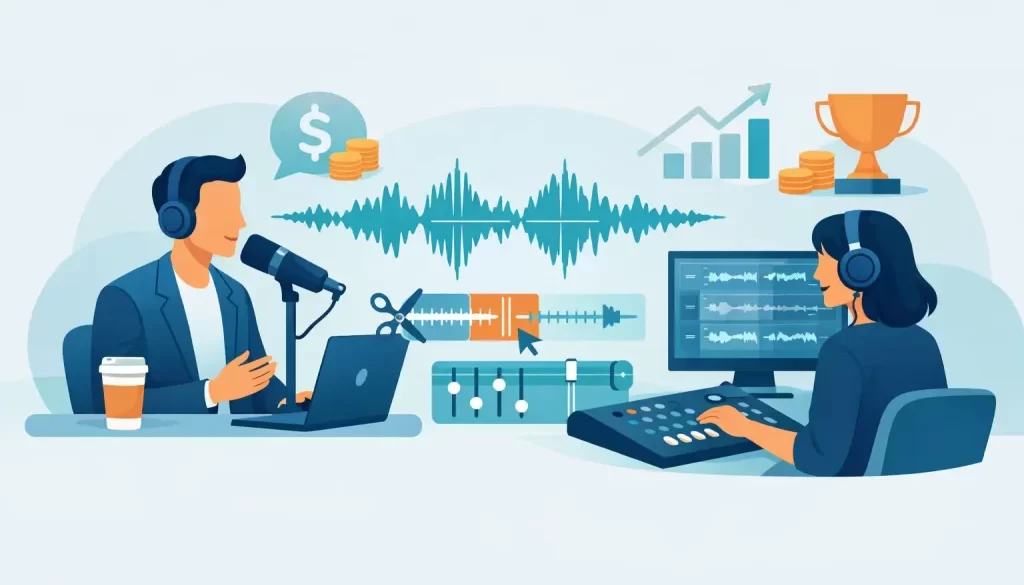
For interview-led founder podcasts, multi-track editing matters as well. If each speaker has been recorded separately, a manual editor can make far more precise decisions around overlap, interruptions, breaths and noise. That usually produces a cleaner, more professional result than relying on automated tools alone.
Music, intros, outros and ad placements also need care. These are small moments, but they contribute to how established your brand sounds. Sloppy transitions or mismatched levels make a podcast feel cobbled together. Clean production makes it feel dependable.
The trade-off between doing it yourself and outsourcing
At the start, many founders try to edit their own episodes. That is understandable. It can feel cost-effective, and there is value in learning what goes into production. If you are publishing occasionally and your format is simple, a DIY approach may be enough for a while.
The problem is that founders tend to underestimate the opportunity cost. An hour spent wrestling with audio is an hour not spent on sales, delivery, hiring or strategy. There is also the quality gap. Editing your own material is slow partly because you remember the conversation, which makes it harder to hear what a listener hears. External editors are better placed to judge pace, clarity and what needs to be cut.
This is where podcast editing for founders becomes less about delegation and more about business focus. Outsourcing does not just save time. It creates consistency, shortens turnaround and gives your show a higher production standard from episode to episode.
That said, not every outsourced service is equal. Fast, cheap editing can be perfectly acceptable for internal content or low-stakes publishing. If your podcast sits close to your brand positioning or sales process, a more careful human-led service is usually the better investment.
Why human editing still matters
Automated tools have improved, but they still make blunt decisions. They can remove filler words mechanically, flatten natural rhythm and miss the nuance of a live conversation. Founder podcasts often include subtle moments that matter – a pause before an important point, a guest story that needs tightening rather than cutting, or a section that sounds more confident with a small restructure.
A human editor listens for intent, not just errors. They can judge whether a pause adds weight or simply slows things down. They can decide whether a tangent should be trimmed, moved or left alone because it reveals personality and trust. That level of judgement is difficult to automate well.
For commercial podcasts, this matters because brand perception is built in small details. Listeners may not consciously notice excellent editing, but they certainly notice poor flow, uneven sound and episodes that feel longer than they need to be.
How founders should think about return on investment
The value of editing is not only heard in the audio file. It shows up in audience behaviour and business outcomes.
A polished episode is easier to listen to, which supports retention. Better retention means more of your message is actually heard. That in turn improves the odds of people subscribing, enquiring, sharing the episode or coming back for the next one. If your show supports lead generation, authority building or sponsor conversations, production quality becomes part of the commercial case.
There is also a reputational return. When a founder sounds composed and professionally presented, the show reinforces confidence in the business behind it. This is particularly important for consultants, agency owners, authors and B2B service providers, where expertise and trust do much of the selling.
Good editing can even protect momentum. Many podcasts fail not because the host runs out of ideas, but because the process becomes too heavy. Reliable support behind the scenes makes consistency more realistic, and consistency is what gives a podcast time to compound.
What to look for in a podcast editing service
If you are considering support, look beyond price per episode. The better question is whether the service helps you publish a commercially credible show with less friction.
Responsiveness matters. So does having one clear point of contact who understands your format, your standards and your voice over time. Founders do not want to re-explain their preferences every week. They want a dependable workflow and confidence that issues will be handled quickly.
Ask how the editing is done. If the service relies heavily on automation, the result may be fast but less refined. Manual editing tends to deliver stronger judgement, especially for interviews and long-form episodes.
Turnaround time matters too, but only in context. A same-day edit sounds attractive, yet speed is only useful if the quality holds up. For some businesses, a regular dependable turnaround is more valuable than chasing the absolute fastest option.
Launch support can also be worth considering if your show is new. Founders often need more than editing. They need help with equipment choices, recording setup, publishing and the practical decisions that stop a podcast sounding amateur from day one. That is where a service-led production partner can make a real difference. Pure Podcasting Ltd is built around that hands-on support, with human editing and direct guidance designed to help clients sound their best and publish with confidence.
Common mistakes founders make with podcast production
The first is assuming content quality alone will carry the show. Strong ideas are essential, but poor delivery still costs you listeners.
The second is underestimating consistency. An excellent episode followed by three patchy ones weakens trust. Listeners and commercial partners both notice when standards vary.
The third is buying on price alone. Cheap editing can look efficient until the show starts sounding rushed, generic or unreliable. At that point, you are not saving money. You are paying for content that underperforms.
The fourth is treating editing as purely corrective. The best editing is not there only to fix mistakes. It enhances clarity, pace and professionalism so the entire episode works harder for the business.
A practical standard to aim for
If you are a founder, your podcast does not need to sound overproduced. It does need to sound clear, consistent and intentional. Your listener should never be distracted by levels, noise, clumsy pacing or awkward cuts. They should be able to focus entirely on the conversation and leave with a stronger impression of your expertise.
That is the standard worth paying for. Not perfection for its own sake, but production quality that supports trust, retention and commercial credibility.
If your podcast is meant to help the business grow, treat editing the same way you would treat design, copy or client experience. People may not always comment on it directly, but they absolutely feel the difference when it is done well.