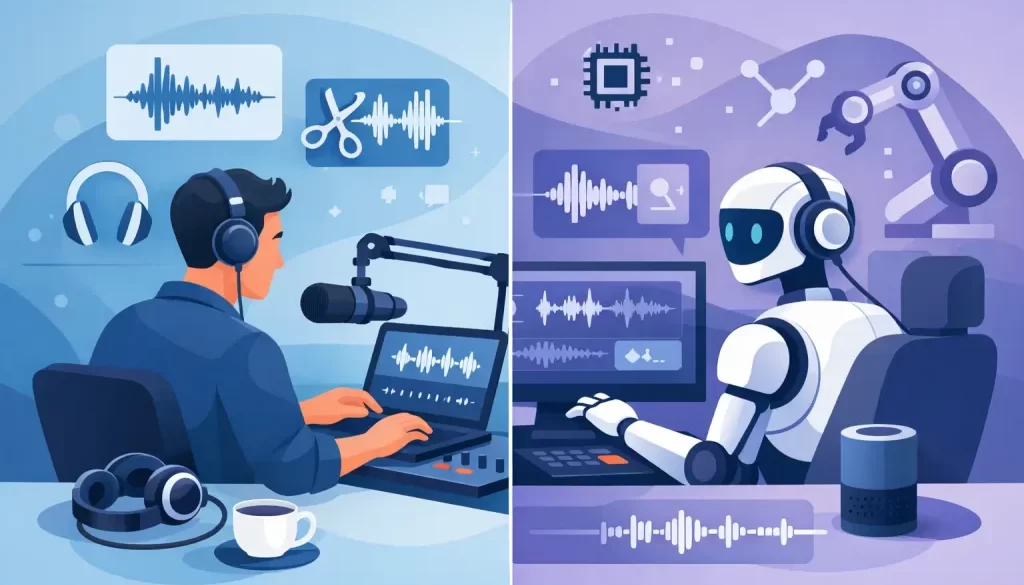
If you have ever listened back to an episode and heard a distracting breath, a clipped word, two people talking over each other, or a guest drifting miles off-mic, you already know this is not a small production detail. The choice between manual vs AI podcast editing affects how professional you sound, how long listeners stay with you, and whether your show feels worth taking seriously.
For some podcasters, AI editing is a useful shortcut. For others, it creates a polished-looking workflow while quietly leaving quality problems behind. If your podcast supports your brand, your authority, or your revenue, the right answer is rarely about novelty. It is about whether the final episode keeps people listening.
Manual vs AI podcast editing: what is the real difference?
At a basic level, AI podcast editing uses software to detect pauses, filler words, silences, background noise, levels, and sometimes speaker changes. It can speed up repetitive clean-up and make basic improvements without much hands-on work.
Manual editing means a real editor listens properly, makes judgement calls, and shapes the episode around context. That includes pacing, tone, interruptions, awkward transitions, emphasis, audio inconsistencies, and the dozens of small decisions that software often cannot interpret accurately.
This is the part many podcasters miss. Editing is not just removing mistakes. It is protecting the listener experience. A human editor hears when a pause adds weight rather than dead air, when a laugh should stay in, when a sentence needs tightening, and when a rough section should be rebuilt rather than simply trimmed.
Where AI podcast editing works well
AI tools can be genuinely useful in the right setting. If you are producing internal content, rough-cutting a solo episode, testing ideas before launch, or trying to reduce admin around simple audio clean-up, AI can save time.
It is particularly effective when recordings are already strong. If you have a controlled environment, consistent mic technique, little cross-talk, and minimal complexity, automated processing can handle some of the repetitive work reasonably well. Silence trimming, basic levelling, and transcript-led editing are often good enough for lower-stakes content.
For creators publishing frequently on limited budgets, that can be attractive. Speed matters. So does cost control. Not every episode needs documentary-level post-production.
That said, acceptable is not the same as excellent. The closer your podcast sits to your business reputation, the less room there is for editing that is merely good enough.
Where AI falls short
AI is fast because it works from patterns. Podcast editing often depends on judgement.
A guest may pause because they are choosing their words carefully, not because the silence should be cut. A host may repeat a phrase for emphasis, not by mistake. Two speakers may overlap slightly in a way that sounds natural to the ear but gets handled clumsily by automation. Background noise may sit under one voice in a way that needs selective treatment rather than blanket processing.
These are not edge cases. They happen constantly in real podcast production.
AI can also be overconfident. It may flatten dynamics, create unnatural cuts, miss subtle mouth noise, leave clumsy transitions, or remove parts of speech that make a person sound human. In trying to make an episode cleaner, it can make it feel less natural and less engaging.
That is a problem if you care about listener retention. People do not stop listening only because audio is bad. They also stop when the rhythm feels odd, the conversation loses warmth, or the production sounds just slightly off. Those softer quality signals matter more than many podcasters realise.
Why manual editing still matters for commercial podcasts
If your podcast is part of your marketing, sales, thought leadership, or monetisation strategy, manual editing usually earns its place quickly.
A professionally edited episode does more than tidy sound. It protects your credibility. It makes interviews feel tighter, solo episodes feel more authoritative, and branded content feel aligned with the level of service you actually provide. If you are asking listeners to trust your expertise, buy your offer, or recommend your show, production quality is part of that decision.
This is especially true for founder-led podcasts, expert interviews, premium branded series, and long-form conversations. These formats rely on nuance. They need editorial judgement as much as technical treatment.
A human editor can hear what supports your message and what weakens it. They can reduce ramble without removing personality. They can preserve natural energy while cleaning up distractions. They can create consistency across episodes, which matters when you are building a recognisable and commercially credible show.
Manual vs AI podcast editing on cost, speed and quality
This is where the trade-off becomes practical.
AI editing is usually cheaper and faster. If your priority is turnaround at the lowest possible cost, it will often win on paper. For podcasters with limited revenue, that can be a sensible short-term decision.
Manual editing takes more time and costs more because someone is actually listening, correcting, balancing, and making choices. But that additional cost is often misunderstood. You are not just paying for labour. You are paying for quality control, consistency, and someone spotting the problems you did not know were there.
The better question is not, which is cheaper? It is, what is the cost of sounding amateur?
If weak editing affects audience trust, completion rates, guest perception, or brand authority, the saving can disappear quickly. A podcast that sounds inconsistent may still get published, but it does not always perform. For businesses, that performance gap matters more than the editing invoice.
Which type of podcaster should choose which?
If you are a new podcaster experimenting with format, publishing casually, or producing simple solo content, AI may be enough for now. It can help you build momentum and remove some of the technical friction that stops many people from ever releasing episodes.
If you are already attracting clients, promoting a business, interviewing high-value guests, or using your podcast as part of a wider commercial strategy, manual editing is usually the stronger choice. The more visible your show becomes, the less forgiving your audience will be of rough edges.
There is also a middle ground. Some podcasters use AI for first-pass clean-up and manual editing for final quality control. That hybrid model can work well when managed properly, especially for shows with regular publishing schedules. But even in a hybrid workflow, the human element is doing the work that protects the end result.
The listener does not care how you edited it
Podcast Audio Pro Kit (Logic Pro Template for Podcast Editing)
This is worth saying plainly. Your audience does not care whether your editor used software, shortcuts, or a fully manual process. They care whether the episode sounds good, feels easy to follow, and respects their time.
That is why editing decisions should start with the listener rather than the tool. If automation helps without compromising the experience, fine. If it creates an episode that sounds efficient but not polished, it is the wrong solution.
In practice, the strongest podcasts are rarely built on convenience alone. They are built on consistency, taste, and attention to detail.
Choosing the right manual vs AI podcast editing workflow
When deciding between manual vs AI podcast editing, think beyond software features and ask a few harder questions. How important is this podcast to your brand? How much revenue could it influence? How forgiving is your audience? How often do you record in imperfect conditions? And how much time do you want to spend fixing problems after they reach your inbox, your guests, or your listeners?
If your goal is simply to get episodes out, AI may cover the basics. If your goal is to sound credible, retain listeners, and create a show that supports real business outcomes, human editing remains the safer investment.
That is why many serious podcasters still choose manual production support. Not because they are resistant to technology, but because they understand where quality actually comes from. Tools can assist. They cannot replace experience, judgement, and care.
At Pure Podcasting Ltd, that distinction matters. A podcast is not just an audio file to process. It is a representation of your brand, your standards, and the value you bring to the people listening.
If you want your podcast to sound its best, choose the workflow that serves the listener first and your reputation second to none.