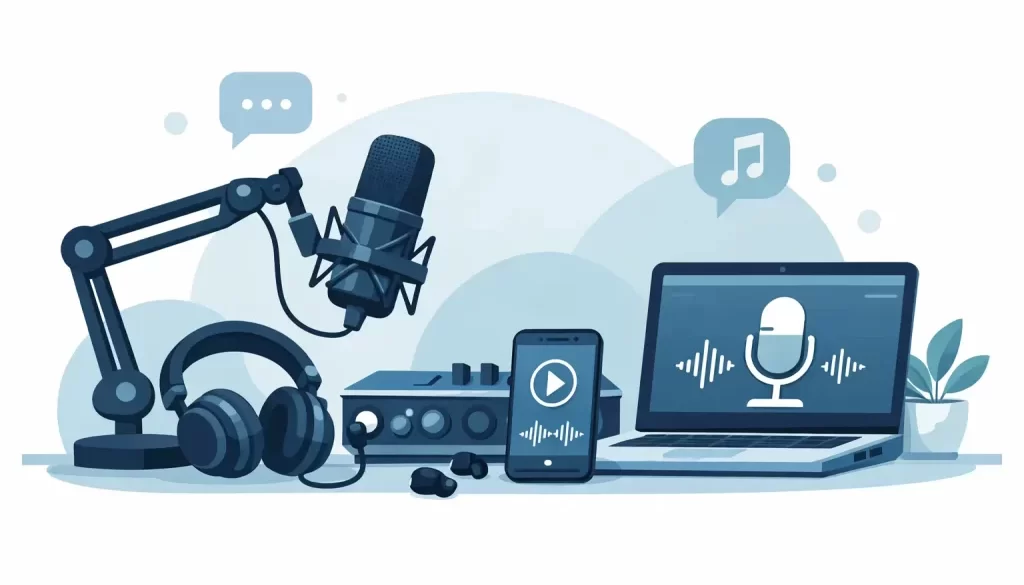
Most new podcasters do not fail because they picked the wrong topic. They struggle because their setup creates avoidable problems – hiss, echo, distorted voices, awkward remote recordings and hours of fixing issues later. Good podcast equipment guidance for beginners is not about buying the most expensive kit. It is about choosing equipment that helps you sound credible from episode one.
If your podcast supports a business, personal brand or commercial goal, that matters more than many people realise. Listeners will forgive a modest setup. They are far less forgiving of poor clarity, inconsistent volume or audio that feels amateur. The right equipment gives you a cleaner recording, a faster production process and a stronger first impression.
Podcast equipment guidance for beginners starts with the microphone
The microphone is the one item worth taking seriously from the outset. It shapes how your voice is captured and it has more impact on perceived quality than almost anything else in your setup.
For most beginners, a dynamic microphone is the safer choice than a condenser. That is because dynamic microphones are generally less sensitive to room noise. If you are recording in a home office, spare bedroom or kitchen table setup, that matters. A condenser can sound excellent in a treated room, but in a normal domestic environment it often captures every hard surface reflection, passing car and laptop fan.
USB microphones are usually the easiest starting point. They connect straight to your computer, keep your setup simple and avoid the extra cost of an audio interface. For solo podcasters, consultants, founders and creators who want to get moving quickly, a good USB dynamic microphone is often the most practical route.
XLR microphones can deliver more flexibility and can make sense if you plan to scale your production, add more hosts or invest in a more advanced signal chain. But that does not automatically make them the better option on day one. If buying XLR gear means stretching your budget and still recording in a poor acoustic space, your priorities are in the wrong order.
The room matters more than many beginners expect
A common mistake is spending heavily on a microphone while ignoring the room. Hard walls, bare desks and open spaces create echo, and no premium mic fixes that. In many cases, a mid-range microphone in a soft furnished room will beat an expensive microphone in a boxy, reflective one.
You do not need a studio build. You do need to reduce reflections. Curtains, rugs, cushions, bookshelves and soft furnishings all help. Even recording closer to a wardrobe full of clothes can improve the result. The aim is not perfection. It is control.
This is where podcast equipment guidance for beginners needs a dose of realism. The best setup is the one that suits your space, your workflow and the standard your audience expects. A founder recording weekly thought leadership episodes has different needs from a business running a branded interview show with guest contributors.
Headphones are not optional
Many beginners see headphones as a minor extra. They are not. Closed-back headphones help you monitor your recording properly, catch issues early and avoid speaker bleed if you are recording through a computer.
You do not need luxury studio headphones to start. You do need a comfortable, reliable pair that gives you a clear sense of mouth noise, plosives, clipping and background noise. If you are conducting remote interviews, headphones become even more important because they prevent your guest audio feeding back into the recording.
In practical terms, a sensible microphone and decent closed-back headphones are a stronger investment than spending the same money on accessories you may not need yet.
Do you need an audio interface?
Sometimes yes, often not immediately.
If you use a USB microphone, you can skip the interface for now. That keeps costs down and reduces setup friction. For many first-time podcasters, simplicity is a commercial advantage because it makes consistency more likely. A setup you can use confidently every week is better than a more advanced one that feels fiddly.
If you choose an XLR microphone, you will need an audio interface. That gives you microphone preamps, gain control and stable connection into your computer. It can also leave room to grow if you plan to add another host, record locally with guests or refine your sound further.
The trade-off is that an interface adds complexity. You have more cables, more gain staging decisions and more room for user error. That is not a reason to avoid one forever. It is simply a reason not to treat it as mandatory for every beginner.
Mic stands, pop filters and cables do matter
These are not the glamorous purchases, but they can save a recording.
A stable microphone stand or boom arm keeps your mic in the correct position and reduces handling noise. A pop filter or foam windscreen helps control plosives on words beginning with p and b. If you are using XLR, reliable cables matter because crackles and intermittent faults are a frustrating way to lose confidence in your setup.
This is also where beginners can overspend. You do not need a designer boom arm or premium boutique cable collection. You need dependable accessories that support a clean, repeatable recording process.
Recording solo, with guests, or remotely changes what you need
The right equipment depends heavily on format.
A solo show is the simplest setup. One good USB or XLR dynamic microphone, closed-back headphones and a controlled room can be enough to produce a professional result.
A two-person in-room podcast requires more planning. You will usually need either two USB microphones feeding into separate systems, or more commonly two XLR microphones into an interface or recorder that can handle multiple inputs. Sharing one microphone between two people rarely sounds polished and usually creates uneven levels.
Remote interviews add another layer. Your own equipment can be excellent, but guest quality varies wildly. In that situation, your setup should prioritise stability and monitoring. Encourage guests to use headphones, record in a soft room and avoid relying on laptop microphones. Better guest preparation often improves final quality more than another hardware upgrade on your side.
What beginners should spend – and where to hold back
Budget matters, but value matters more.
If you are just starting, it is usually sensible to invest enough to avoid obvious quality issues rather than chasing a fully professional studio setup. In most cases, your first budget should go towards a microphone, headphones and basic acoustic improvement in the room. That gives you the clearest return.
Where should you hold back? Usually on mixers, elaborate lighting-style desk rigs, expensive branded accessories and software subscriptions you do not yet need. None of those items will rescue a poor recording chain.
There is also a business point here. If your podcast supports lead generation, client trust or brand authority, poor audio carries a cost. It can reduce listener retention and make your content feel less credible than it actually is. Spending wisely on the essentials is not vanity. It is part of presenting your business properly.
The best beginner setup is the one you will actually use
This is the part many guides miss. A technically impressive setup is useless if it slows you down, confuses you or makes publishing inconsistent.
Beginners often benefit from a setup with fewer points of failure. One microphone. One pair of headphones. A quiet room. A repeatable recording position. That is not cutting corners. That is creating a workflow you can trust.
As your show grows, your equipment can grow with it. You may add an interface, upgrade your microphone, improve room treatment or build a more advanced remote recording workflow. But those decisions should follow your format, your goals and your publishing rhythm, not internet pressure.
For podcasters who want a commercially credible show, the smartest approach is to keep the recording chain clean and let professional editing do the refinement. That combination usually outperforms a bloated gear list and inconsistent technique. It is one reason businesses such as Pure Podcasting focus not just on editing, but on giving beginners practical launch support that prevents expensive mistakes early on.
A good setup should make you feel confident when you press record. If your equipment is clear, reliable and suited to your environment, you are already much closer to sounding like the kind of podcast people come back to.