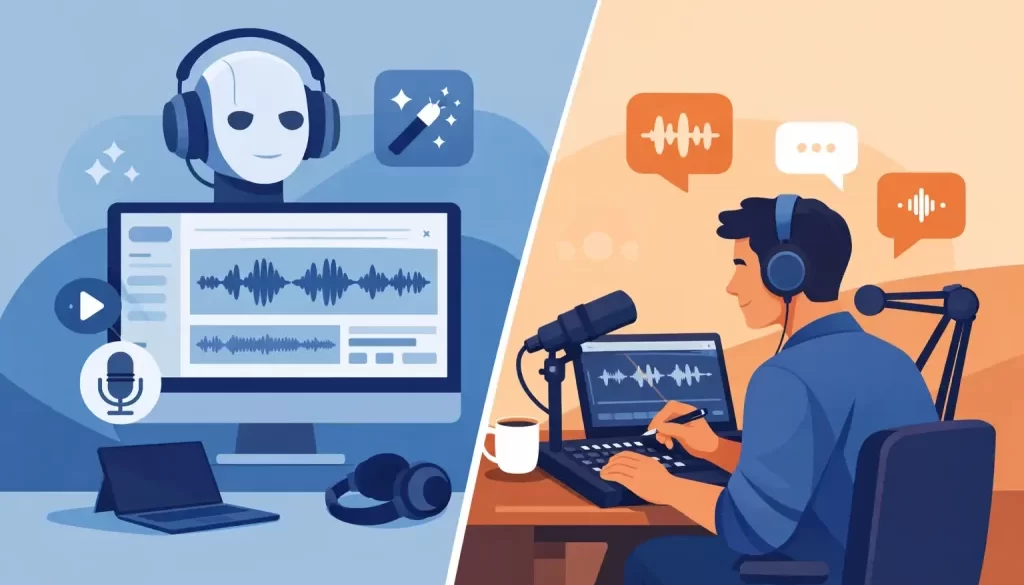
You can publish a podcast with AI-edited audio and hope nobody notices the rough edges. Or you can treat editing as part of the product your audience hears every week. That is the real question behind descript vs human podcast editor – not which tool is newer, but which approach protects your brand, your listener retention, and the overall credibility of your show.
For some podcasters, Descript is a sensible part of the workflow. It is fast, accessible and genuinely useful for cutting content by editing text. For others, especially founders, brands, consultants and businesses using a podcast to generate trust and revenue, a human editor is not a luxury. It is quality control.
Descript vs human podcast editor: what are you actually comparing?
Descript is software. A human podcast editor is a specialist making judgement calls episode by episode. Those are not the same category of solution, even if they appear to solve the same problem.
Descript can transcribe your recording, remove some filler words, help with basic levelling and let you move sections around quickly. It is particularly attractive to solo creators who need speed and want more control over the editing process without learning a traditional DAW from scratch.
A human editor does something different. They listen as a listener. They hear where a sentence lands awkwardly, where a guest interrupts at the wrong moment, where the pacing drags, where room tone changes, where a laugh should stay because it adds warmth, and where a pause should go because it improves clarity. Good editing is not only technical cleanup. It is editorial judgement.
That distinction matters more as your podcast becomes commercially important. If the show represents your company, supports client acquisition, sells a course, attracts sponsors or builds authority in your market, the stakes are higher than simply getting an episode out.
Where Descript works well
Descript deserves credit for making podcast editing more approachable. For early-stage podcasters, that has real value.
If you are testing a new concept, recording short solo episodes, or producing internal content with modest expectations, Descript can help you move quickly. Its text-based interface is intuitive. You do not need deep production knowledge to make reasonable edits. It can also be useful for repurposing content, creating transcripts and pulling clips for social media.
There is also a cost argument. If your budget is tight and your priority is consistency over perfection, software can be a practical starting point. Many podcasters would rather launch with a workable setup than delay for months trying to make everything flawless.
This is where the answer is not dogmatic. A tool like Descript can absolutely have a place. The issue is not whether it is useful. The issue is whether it is enough for the level of show you are trying to build.
Where a human podcast editor pulls ahead
A human editor becomes more valuable as complexity, expectations and reputational risk increase.
Multi-speaker episodes are a good example. Conversations with guests rarely behave neatly. People talk over one another, online calls drift, levels vary, background noise changes and key points get buried inside long answers. Software may tidy some of this, but it will not always know what should be prioritised. A human editor can shape the episode so it feels natural, clear and engaging rather than merely processed.
Then there is taste. Automated filler-word removal can make speech sound oddly clipped. Aggressive noise reduction can introduce artefacts. Auto-levelling can flatten a conversation so it loses energy. What sounds efficient on paper can sound cheap in headphones.
A skilled editor is listening for more than mistakes. They are protecting flow, warmth and authority. That matters because listeners are quick to notice when a podcast sounds inconsistent, even if they cannot describe exactly why.
Audio quality is not vanity
Many business owners underestimate how much production quality affects trust. Listeners may forgive the occasional imperfection, but repeated distractions chip away at confidence. If your audio sounds thin, uneven or amateur, some people will assume your services are too.
That may feel harsh, but it is how audience perception works. Your podcast is often consumed while somebody is driving, walking, travelling or multitasking. They are not sitting there generously grading your effort. They are deciding whether to keep listening.
A human editor can reduce those friction points in ways software often cannot. Breath control, pacing adjustments, content trimming, dialogue shaping, tonal consistency and manual cleanup all contribute to a smoother experience. Better listening leads to stronger retention. Stronger retention gives your message more chance to do its job.
Descript vs human podcast editor for branded and monetised shows
If your podcast is tied to revenue, the comparison changes quickly.
A branded podcast is not just content. It is sales support, positioning and relationship-building. When an episode sounds polished, your business sounds organised and credible. When it sounds rushed, over-processed or poorly judged, the opposite can happen.
For monetised podcasts, editing also affects ad-read delivery, sponsor confidence and how professionally the show handles intros, outros and transitions. Advertisers and commercial partners do not only care about download numbers. They care about the environment their message appears in.
This is one reason many serious podcasters move away from a DIY software-only workflow as their show grows. The opportunity cost becomes clearer. Time spent wrestling with edits is time not spent recording, promoting, selling or serving clients. And the cost of mediocre production may be hidden until audience growth stalls.
The trade-off is speed versus judgement
Software is often quicker at the first pass. Human editing is usually better at the final result.
If your only metric is how fast you can cut an episode, Descript has an obvious advantage. But speed alone is not the whole picture. Fast editing that leaves awkward cuts, inconsistent tone and weak pacing can create more problems than it solves.
A human editor may not always be as instant as automated processing, but the time saved on revisions, second-guessing and quality issues often evens things out. More importantly, you gain confidence that each episode reflects your standard.
That reliability matters if you publish regularly. It matters even more if you have guests, deadlines, a wider content team or a show that supports your wider business goals.
A blended workflow can work
This does not have to be a strict either-or decision.
Some podcasters use Descript for transcription, rough cuts or content review, then pass the episode to a human editor for detailed post-production. That can be an efficient middle ground. You keep some of the convenience of AI-assisted workflow while still benefiting from human judgement where it counts.
For many shows, that is the sensible answer. Use software where it saves time. Use an editor where mistakes are expensive.
At Pure Podcasting Ltd, this is often where clients see the difference. They may start by thinking editing is mainly about removing ums and ahs. Very quickly, they realise the real value is in having a reliable specialist who understands pacing, clarity, consistency and what makes a show sound commercially credible.
So which should you choose?
Choose Descript if you are early on, budget-conscious, comfortable being hands-on and willing to accept that the result may be good rather than exceptional. It is a strong tool for getting started and keeping production moving.
Choose a human podcast editor if your show represents your brand, supports sales, needs to sound consistently professional or involves enough complexity that poor editing will be obvious. The more serious your goals, the more sensible human support becomes.
If you are still unsure, ask yourself a simpler question. When somebody presses play on your podcast for the first time, do you want them to hear something efficiently processed, or something carefully produced?
That is usually where the decision becomes clear. Editing is not just post-production. It is part of how your audience experiences your expertise. And when your podcast is meant to build trust, quality is rarely the place to cut corners.
The right choice is the one that helps you sound your best, keep your standards high and make every episode feel worthy of the business behind it.